Aktive Galaxienkerne (AGN) sind eine der wichtigsten Quellklassen der Hochenergieastrophysik. Dabei bilden AGNs eine große Klasse von Quellen, von denen insbesondere Blazare relevant sind. AGNs sind zuerst einmal eine kompakte Region im Zentrum einer Galaxie, die über weite Teile des elektromagnetischen Spektrums eine signifikant erhöhte Luminosität aufweist. Diese kompakten Regionen haben drei konstituierende Elemente: ein supermassives schwarzes Loch, um das sich eine Akkretionsscheibe ausbildet, und eine dazu senkrechte verlaufende Plasmaemission, den Jet.
Leptonische Modelle
|
Erste Modellierungen von AGN mit leptonischen Modellen wurden mit dem SED-Code unternommen. Hier wird ein vorgegebenes Elektronenenergiespektrum in eine homogene Strahlungszone injiziert. Dort finden verschiedene Strahlungsprozesse (Synchrotronstrahlung, Synchrotronselbstabsorption, Inverse-Compton-Streuung) statt. Die Gleichungen für Elektronen- und Photonenverteilung werden dabei zeitabhängig gelöst. Effektiv wird also ein zeitabhängiges SSC-Modell implementiert. Dieser Code wurde z.B. für die Modellierung von 1ES1218+30.4 verwendet (Spectral modelling of 1 ES 1218+30.4 (Rüger, Spanier, and Mannheim 2010 Monthly Notices of the Royal Astronomical Society )) Dieses Modell ermöglicht nicht nur die Modellierung statischer Spektren, sondern bis zu einem gewissen Grad auch die Modellierung der Variabilität. Während die Strahlungsprozesse - und die damit verbundene Entwicklung der Teilchenverteilung - selbstkonsistent dargestellt werden, kommt Variabiilität nur durch externe Faktoren (z.B. ein plötzliche Änderung des injizierten Teilchenspektrums) zu stande. |
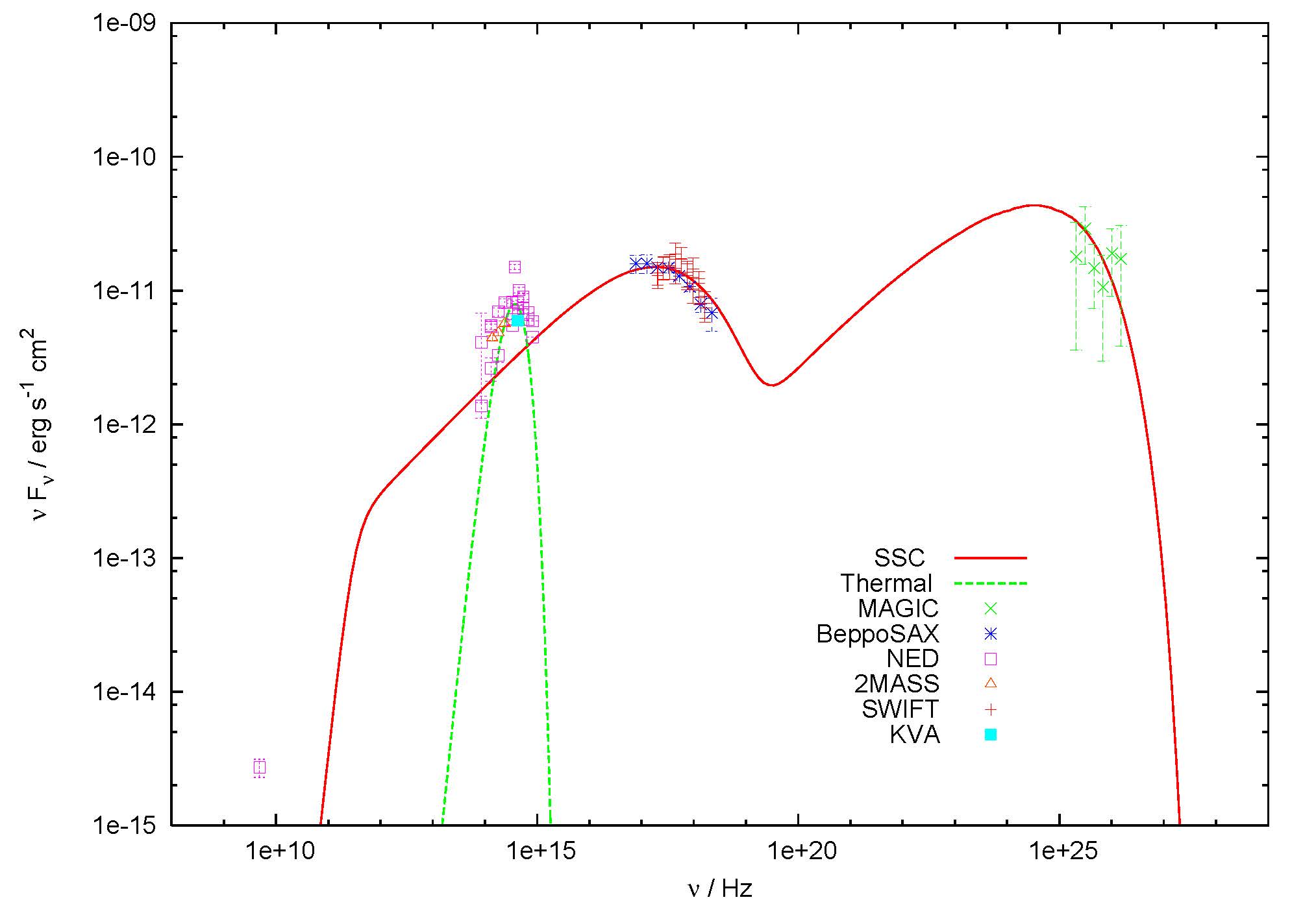 Modellierung von 1ES1218+30.4 mit dem SED-Code. Quelle: (Spectral modelling of 1 ES 1218+30.4 (Rüger, Spanier, and Mannheim 2010 Monthly Notices of the Royal Astronomical Society)) |
|
Um auch das Teilchenspektrum selbstkonsistent mitzumodellieren, wurde der COJONES-Code entwickelt. Er unterscheidet sich vom SED-Code im wesentlich dadurch, dass er statt einer einzelnen homogenen Strahlungszone eine Beschleunigungs- und eine Strahlungszone enthält. In der Beschleunigungszone wird im wesentlichen die kinetische Gleichung der Elektronen gelöst, wobei dort Fermi-I und -II Beschleunigung berücksichtigt werden. Damit können Beschleunigung und Strahlung simultan und selbstkonsistent simuliert werden. Ein typisches Szenario ist dabei die Modellierung von Variabilität durch ein Veränderung der Injektion von Primärteilchen. Da diese dann auch erst beschleunigt werden, ergibt sich ein anderes - und komplexeres - Muster als beim einfachen SED-Modell. Eine erste Anwendung ist dabei die Quelle 1ES 1218+30.4 (Modelling the variability of 1ES1218+30.4 (Weidinger and Spanier 2010 Astronomy and Astrophysics )) Diese Quelle wurde schon mit SED modelliert, hier ging es aber darum zu zeigen, dass neuere Beobachtungen mit VERITAS weiterhin mit einem leptonischen Modell vereinbar sind. Durch die zeitabhängige Lösung der kinetischen Gleichungen ist es möglich, die Variabilität selbstkonsistent zu modellieren. Hier im Bild rechts sieht man letztlich die Responsefunction des System auf eine stufenförmigen Änderung der injizierten Dichte. Dabei ist zu erkennen, dass der Anstieg und der Abfall der Lichtkurve nicht symmetrisch zueinander sind (der Anstieg wird durch die Zeitskalen der Beschleunigung bestimmt, der Abfall durch Kühlzeitskalen). Weiterhin sind die Lichtkurven in den verschiedenen Bändern auch deutlich unterschiedlich zueinander. |
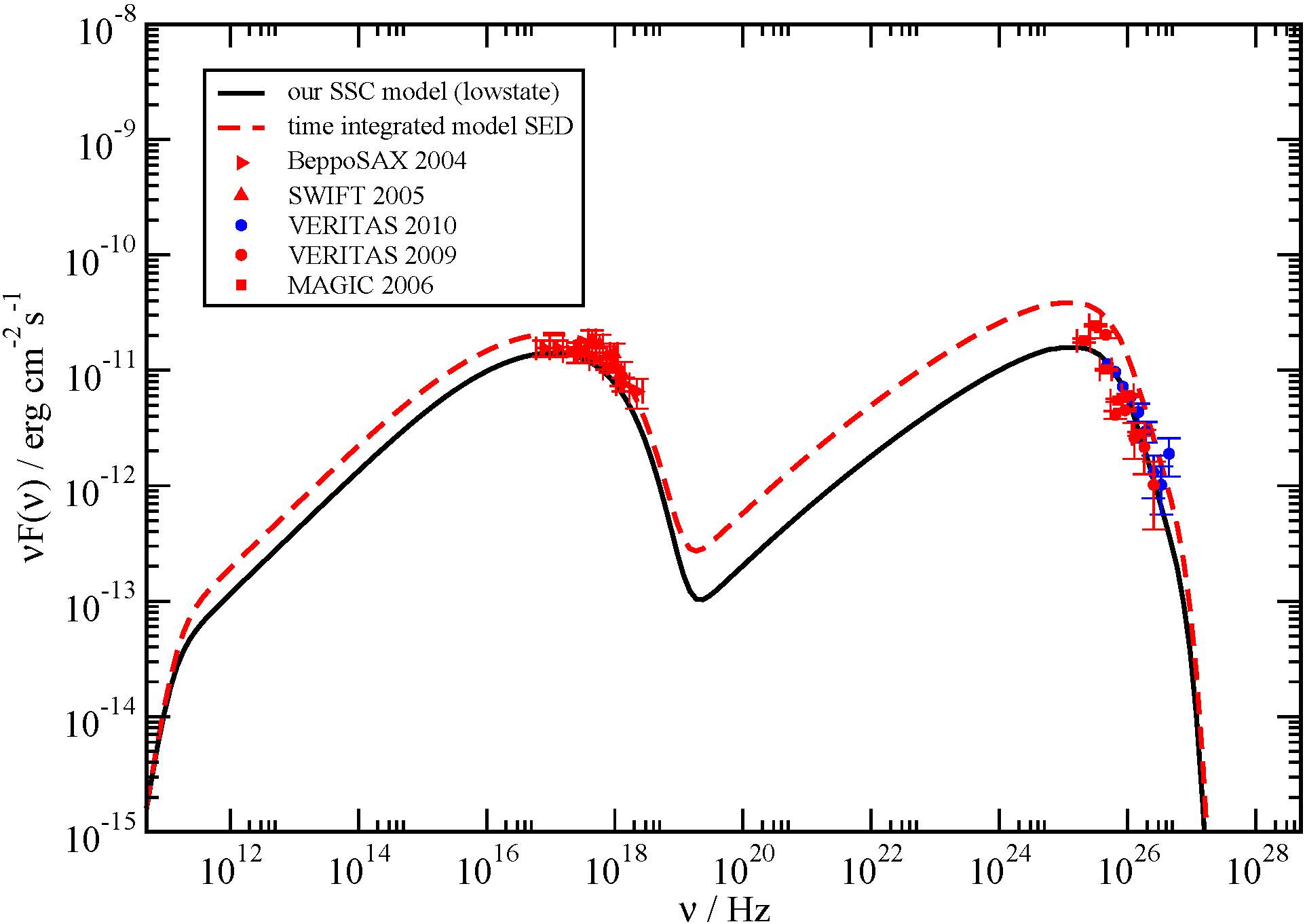 Modellierung von 1ES1218+30.4 im niedrigen Flußzustand mit dem COJONES-Code. Quelle: Modelling the variability of 1ES1218+30.4 (Weidinger and Spanier 2010 Astronomy and Astrophysics ) 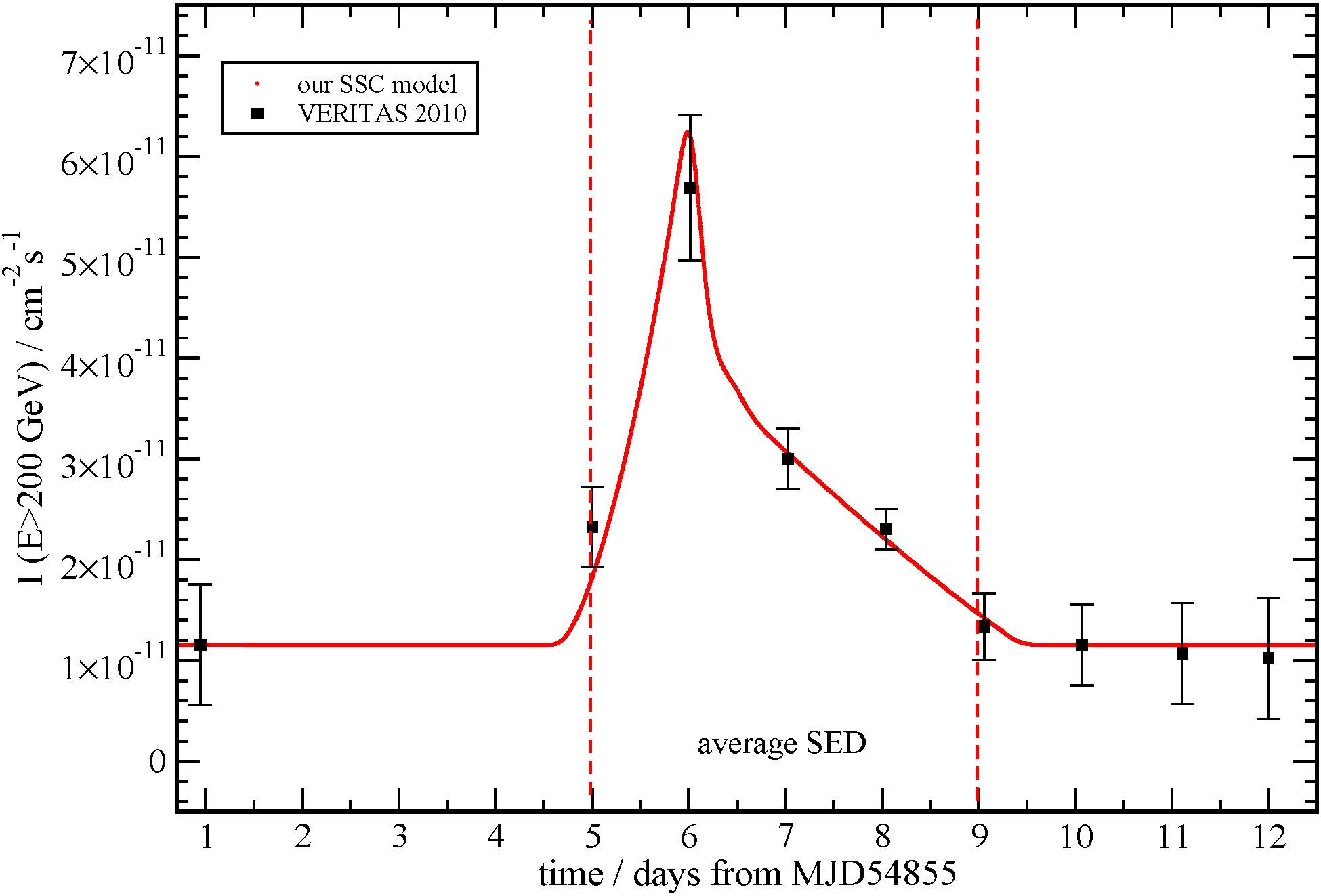 Lichtkurve von 1ES1218+30.4 mit dem COJONES-Code. Quelle: Modelling the variability of 1ES1218+30.4 (Weidinger and Spanier 2010 Astronomy and Astrophysics ) |
|
Das COJONES-Modell wurde auch für deutlich komplexere Variabilitätsmuster angewendet, z.B. die extreme Kurzzeitvariabilität von PKS 2155-30.4 Bei dieser Quelle wurde ein komplexes Variabilitätsmuster im Minutenbereich gemessen. In Modelling the steady state spectral energy distribution of the BL-Lac Object PKS 2155-30.4 using a selfconsistent SSC model (Weidinger, Rüger, and Spanier 2010 Astrophysics and Space Sciences Transactions ) konnte dieses Muster nachgebildet werden (s. Abbildung rechts). Während das Beschleunigungs- und Strahlungsmodell in sich selbstkonsistent ist, ist die externe Änderung der Dichte nicht im Modell erklärbar. Ob tatsächlich eine Änderung der externen Dichte für die Variabiilität verantwortlich ist, ließe sich durch Multibandanalysen bestimmen, da das Verhalten in anderen Frequenzen charakteristische Änderungen aufweisen sollte. |
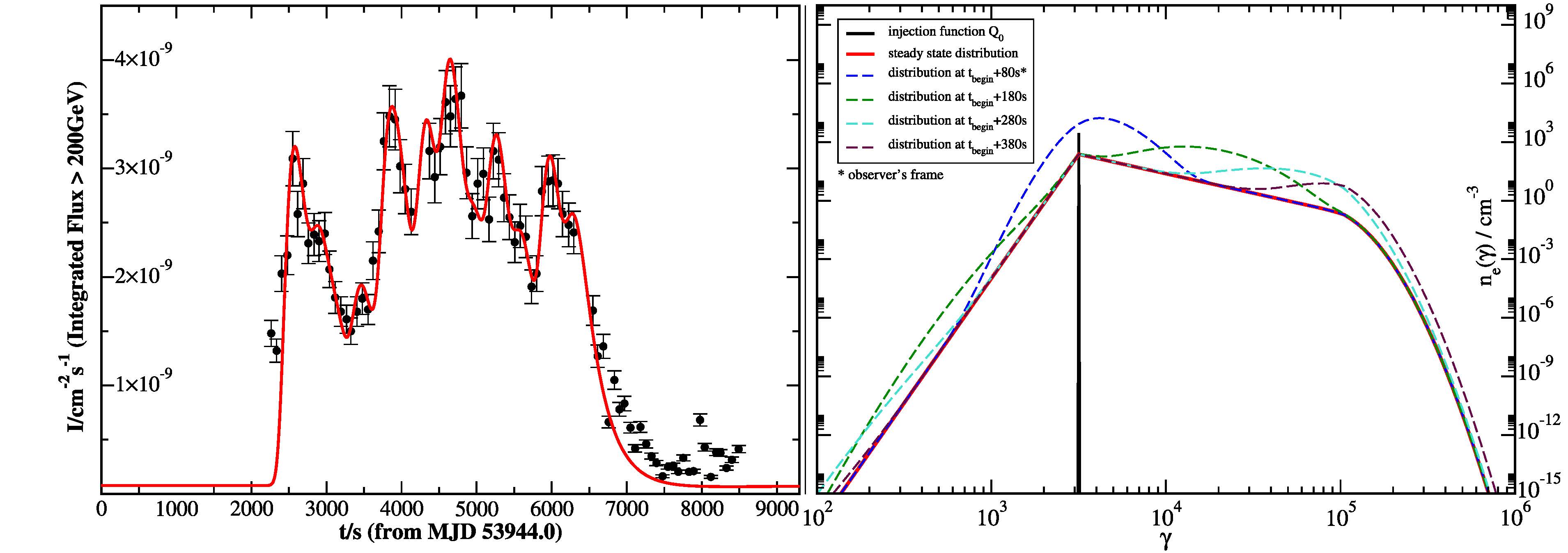 Modellierung der extremen Kurzzeitvariabilität von PKS 2155 dem COJONES-Code. Quelle: Modelling the steady state spectral energy distribution of the BL-Lac Object PKS 2155-30.4 using a selfconsistent SSC model (Weidinger, Rüger, and Spanier 2010 Astrophysics and Space Sciences Transactions ) |
Hadronische Modelle
|
In vielen AGN werden neben Elektroen auch Protonen zu nichtthermischen Energien beschleunigt. Diese Protonen können dann auch zur Strahlung beitragen. Im einfachsten Fall ist der Beitrag der Protonen nur Synchrotronstrahlung der Protonen (die dafür notwendigen hohen Magnetfeldern sind meist vorhanden, da hohe Magnetfelder auch notwendig sind, um die Protonen in der Quelle zu halten). Durch Proton-Proton oder Proton-Photon Kollisionen können allerdings auch Sekundärteilchen entstehen, die zur Strahlung beitragen. In den meisten AGN ist die Materiedichte viel zu gering, als das p-p-Prozesse eine Rolle spielen können. p-γ-Prozesse sind hingegen häufig relevant. Dabei entstehen neutrale Pionen π0, die wiederum unter Ausstrahlung von zwei Photonen zerfallen und geladene Pionen π±, die letztendlich zu Elektronen und Positronen zerfallen. Diese Teilchen können jederzeit Synchrotronstrahlung emittieren. Die finalen Elektronen und Positronen können dann wiederum durch Paarerzeugung und -vernichtung eine Rolle spielen. Eine wichtige Rolle spielt dabei die Bestimmung der Streuquerschnitte. Eine mathematische einfach zu handhabende Methode wurde in Simplified Models for Photohadronic Interactions in Cosmic Accelerators (Hümmer, Rüger, Spanier, and Winter 2010 The Astrophysical Journal ) entwickelt. Der wichtigste Aspekt dabei ist, dass hier Doppelintegrale über Protonen- UND Photonenverteilung vermieden werden konnten. |
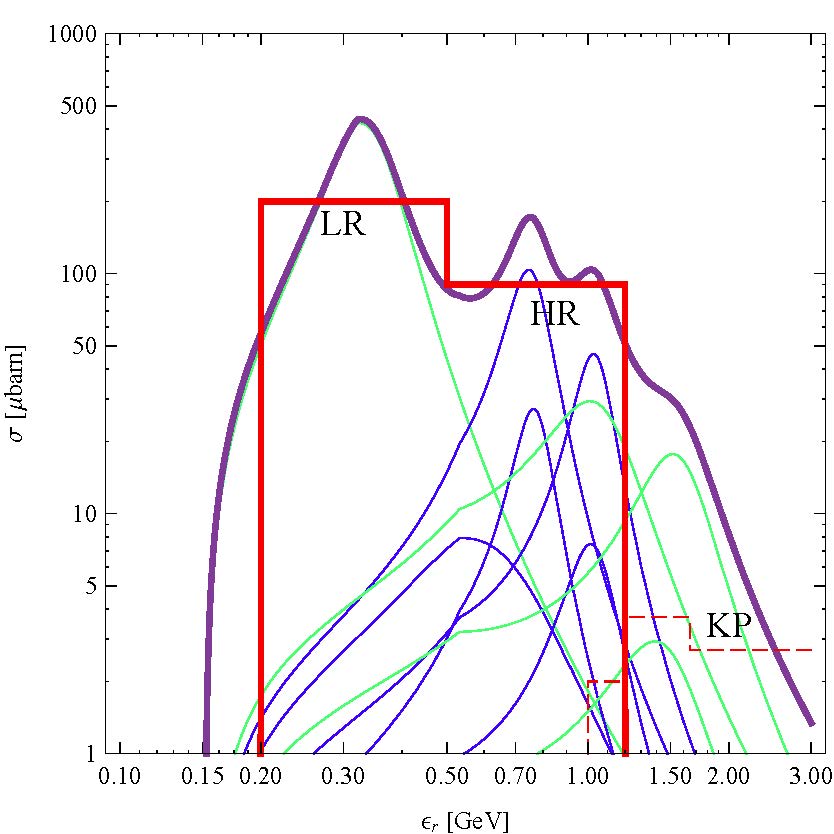 Parametrisierung des photo-hadronischen Wirkungsquerschnitts mit dem Modell von Hümmer et al. Quelle: Simplified Models for Photohadronic Interactions in Cosmic Accelerators (Hümmer, Rüger, Spanier, and Winter 2010 The Astrophysical Journal ) |
|
Die oben erwähnte Parametrisierung der Streuquerschnitte wurde auch in COJONES verwendet, um hadronische Quellen zu modellieren. In das Modellsystem werden dazu zusätzlich auch Protonen injiziert, die genau wie die Elektronen beschleunigt werden (alleine die Beschleunigungszeit für die Protonen ist um den quadrierten Massenfaktor kleiner). Damit sind dann neben den leptonischen Prozesssen insbesondere Proton-Synchrotron, π0-Zerfall, Elektron/Positron-Erzeugung aus π± und Paarerzeugung/-vernichtung implementiert. Eine typische Anwendung wird in A self-consistent and time-dependent hybrid blazar emission model. Properties and application (Weidinger and Spanier 2015 Astronomy and Astrophysics ) diskutiert (Bilder dazu rechts). Die spektrale Energieverteilung zeigt hier bei 1ES1011 leichte Unterschiede - im wesentlichen ist der Hochenergiebereich flacher als der Synchrotronpeak. Die Quelle 1ES1011 ist allerdings eine Quelle am Übergangsbereich von HBL und LBL Quellen. Für Flat Spectrum Radio Quasars wird erwartet, dass der Einfluß der Protonen stärker wird. Ein deutlich anderes Bild ergibt sich bei der Betrachtung von Lichtkurven: In leptonischen Modellen unterscheiden sich die Lichtkurven in einzelnen Bändern nicht sehr deutlich, typischer ist die Form ähnlich es gibt aber meist eine zeitliche Verschiebung. Hier sieht man allerdings, dass sich stark unterschiedliche Formen und sogar sogenannte Orphan Flares ergeben können, also starke Flussanstiege in einem Energieband, die in anderen Bändern nicht auftreten. Dies lässt sich damit erklären, dass die Zeitskalen und Emissionsprozesse von Elektronen und Protonen entkoppeln. Während also bei der Injektion von Teilchen die Elektronen schnell beschleunigt werden und ebenso schnell strahlen, brauchen die Protonen sehr lange, um relevante Energien zu erreichen. Da hier in diesem speziellen Fall die Elektronen und Positronen aus p-γ-Stösse relevant sind, kaskadieren diese auch von hohen Energien runter zu niedrigen Energien. Aus der reinen Betrachtung der spektralen Energieverteilung ist es meist nicht direkt möglich, leptonische und hadronische Strahlungsprozesse zu unterscheiden. Die Lichtkurven hingegen sprechen eine deutlichere Sprache. |
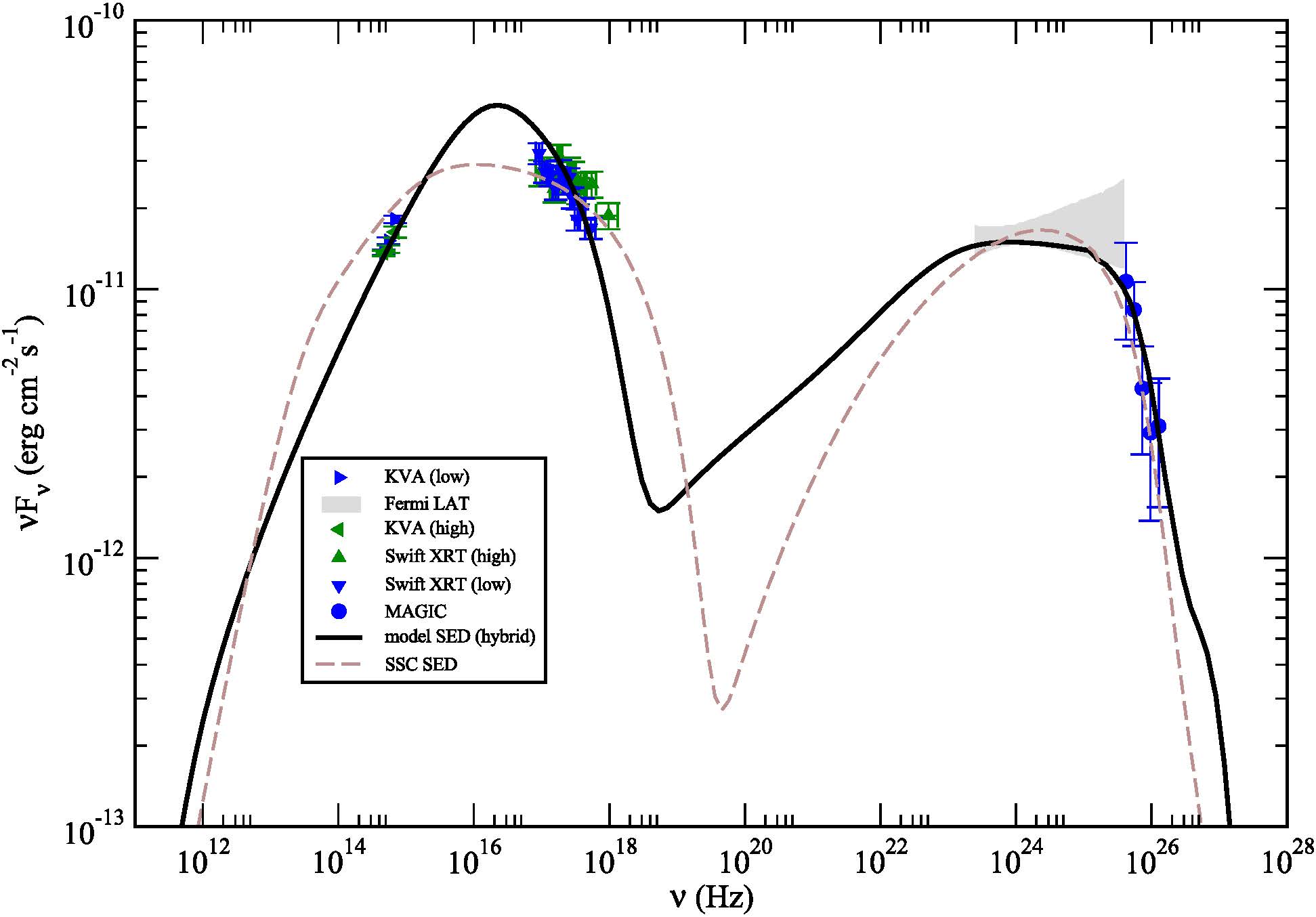 Modellierung von 1ES1011 mit dem hadronischen COJONES-Code. Quelle: A self-consistent and time-dependent hybrid blazar emission model. Properties and application (Weidinger and Spanier 2015 Astronomy and Astrophysics ) 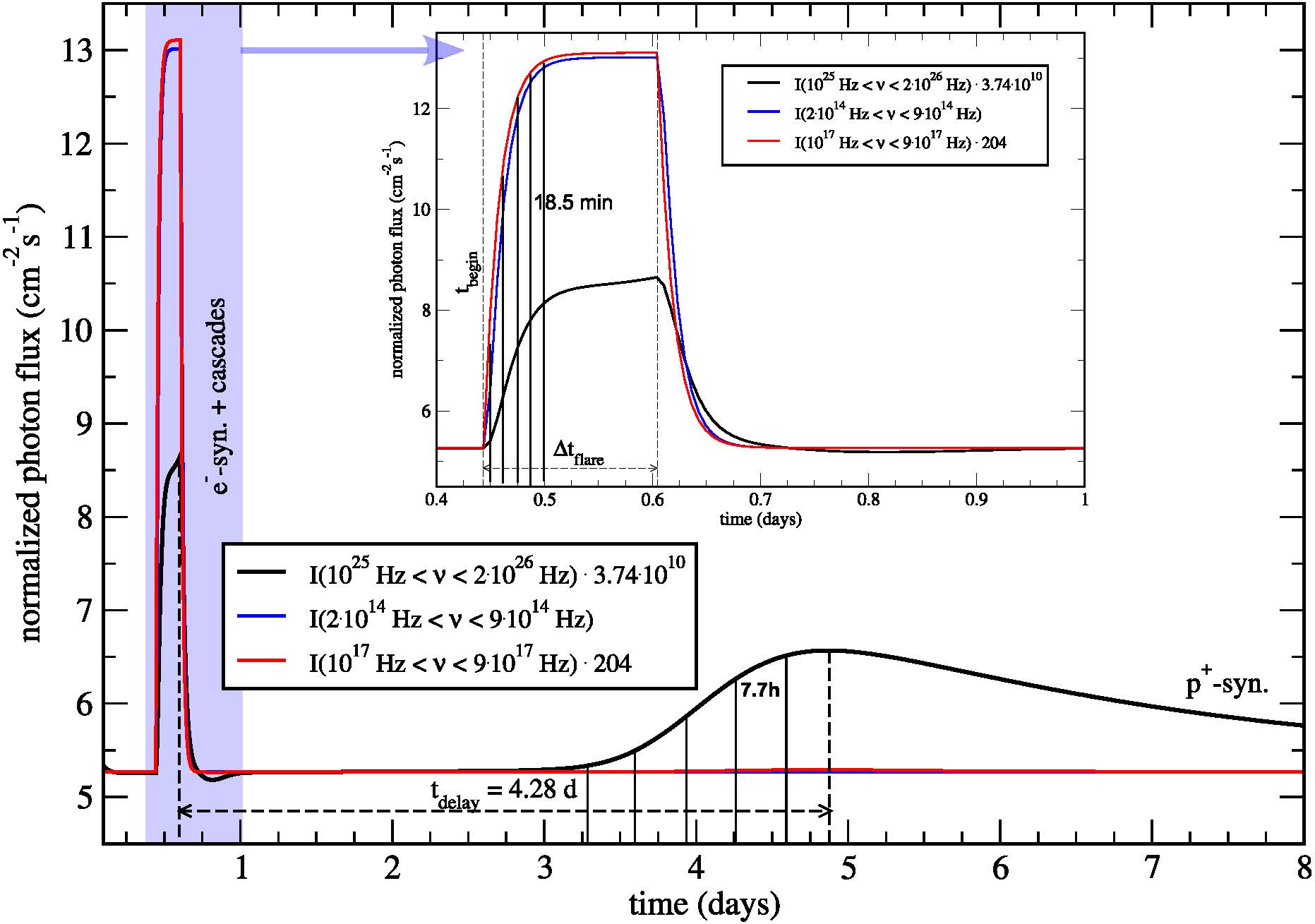 Lichtkurve von 1ES1011 mit dem hadronischen COJONES-Code. Quelle: A self-consistent and time-dependent hybrid blazar emission model. Properties and application (Weidinger and Spanier 2015 Astronomy and Astrophysics ) |
|
Aus dem weiter unten beschriebenen UNICORN Code wurde UNICORN-0D als Nachfolger von COJONES entwickelt. Neben zahlreichen technischen Neuerungen (CUDA-Support, MPI-Parallelisierung, HDF5-Output) wurden unter anderem physikalische Prozesse wie die Synchrotronstrahlung instabiler Teilchen integriert. Durch die hohe Geschwindigkeit von UNICORN-0D war es in AGN neutrino flux estimates for a realistic hybrid model (Richter und Spanier 2018, Astroparticle Physics) möglich, eine Reihenuntersuchung durchzuführen: Für einen Satz von Modellquellen wurde untersucht, wie viele Neutrinos man aus einer solchen Quelle mit IceCUBE detektieren könnte. Dabei wurden das Magnetfeld und die Injektionsraten von Elektronen und Protonen über einen weiten Bereich variiert. Es zeigt sich dabei, dass ein einfacher Zusammenhang von Gammabeobachtugnen und Neutrinodetektion nicht möglich ist. Die Abschätzung "ein Photon = ein Neutrino" ist also nicht haltbar. |
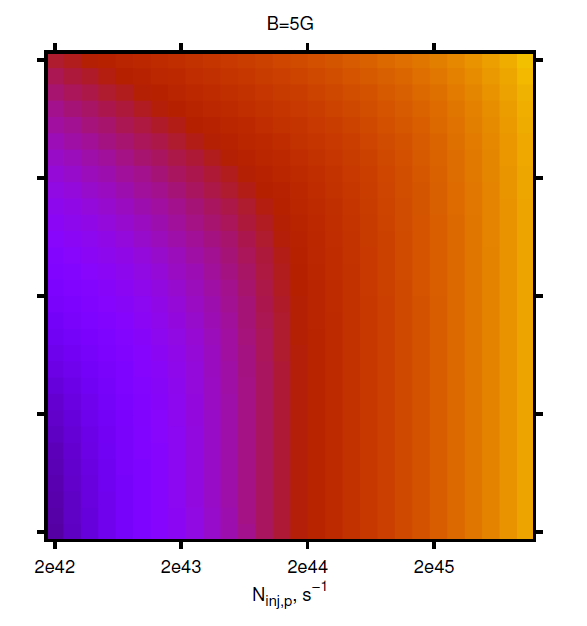 Simulierte Detektionsraten von IceCUBE Quelle: AGN neutrino flux estimates for a realistic hybrid model (Richter und Spanier 2018, Astroparticle Physics) |
Ortsaufgelöste Modelle
|
Eine Weiterentwicklung der AGN-Modellierung ist die ortsaufgelöste Modellierung mit dem UNICORN-Code: Hier wird in Jetrichtung das Simulationsgebiet aufgeteilt. Die Teilchenbeschleunigung wird über Teilchenstreuung an einem künstlichen Fluidschock dargestellt. Eine Anwendung ist dabei die langwellige Radioemission von AGN. Bisherige AGN-Modelle waren nicht in der Lage, die Daten bei sehr niedrigen Frequenzen zu treffen. Das Paradigma dazu war bisher "Die Strahlung wird von ausgekühlten Elektronen erzeugt". Mit UNICORN bestand die Möglichkeit, dieses Paradigma zu testen. In A Numerical Model of Parsec-scale SSC Morphologies and Their Radio Emission (Richter and Spanier 2016 The Astrophysical Journal ) wird gezeigt, dass in einem zylindrischen Jet die Elektronenkühlung nicht effizient genug wäre. Tatsächlich lässt sich aus den Messdaten zeigen, dass die korrekten Radiodaten nur unter Annahme eines logarithmischen Jetprofils getroffen werden. Im Bild rechts ist die für Markarian 501 gezeigt. |
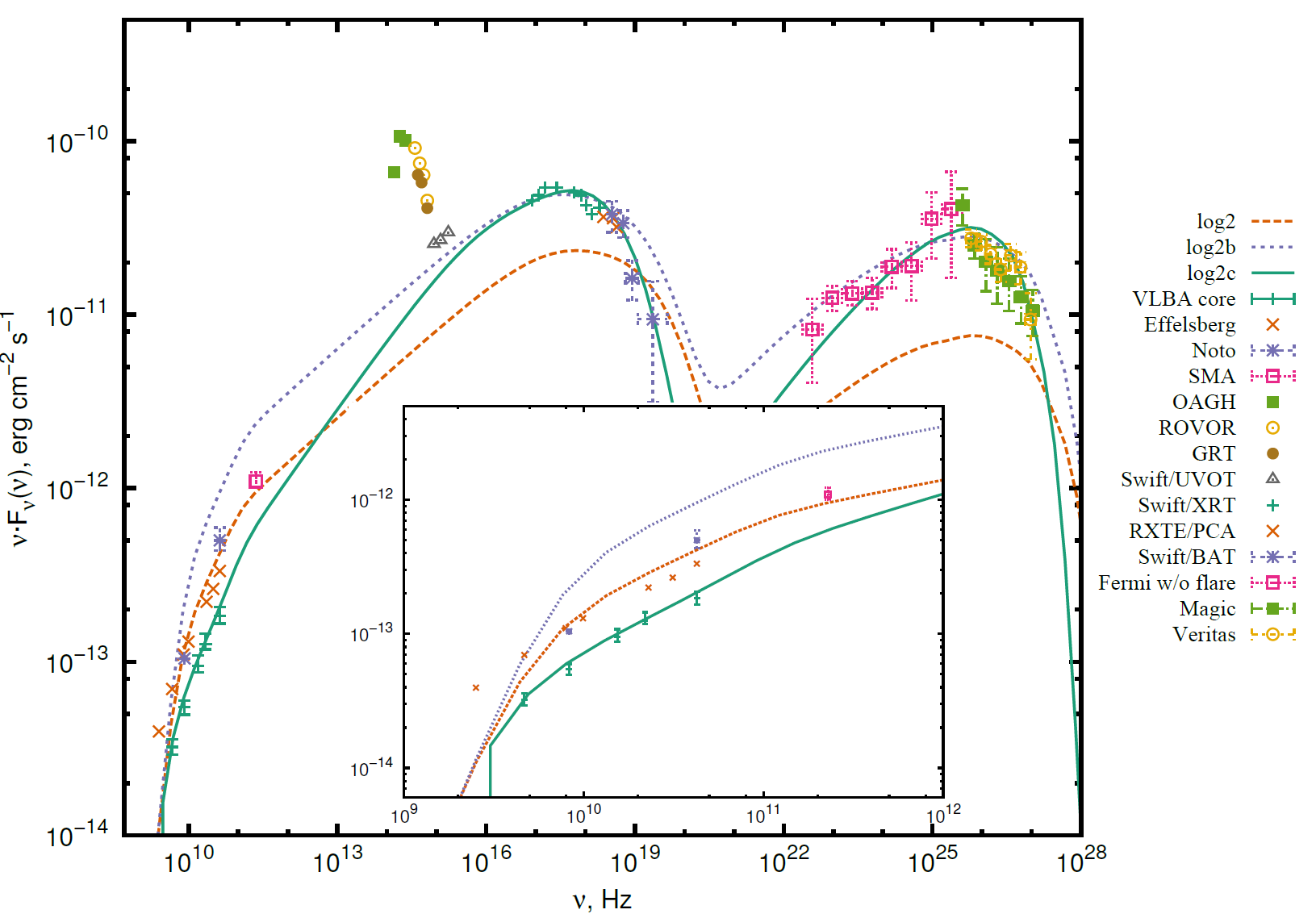 SED von Mrk 501 für verschiedene Jetformen. Es zeigt sich, dass nur eine bestimme logarithmische Form die Radiodaten korrekt wiedergibt. Quelle: A Numerical Model of Parsec-scale SSC Morphologies and Their Radio Emission (Richter and Spanier 2016 The Astrophysical Journal ) |
|
Mit ortsaufgelösten Modellen lässt sich auch ein anderes Problem angehen: Für Variabilitätsszenarien wird meist angenommen, dass sich irgendeine Größe ändert. Woher diese Änderung kommt, wird aber nicht spezifiziert. Mit UNICORN ist es nun mögich ein bestimmtes physikalisches Modell zu testen: Multiple Schocks. In Multi-band implications of external-IC flares (Richter and Spanier 2015 Astroparticle Physics ) wurde verglichen, wie sich Lichtkurven für verschiedene Szenarien unterscheiden. Tatsächlich wurde dabei für einen bestimmten Satz Beobachtungen gezeigt, dass nur multiple Schocks die Lichtkurven erklären können. |
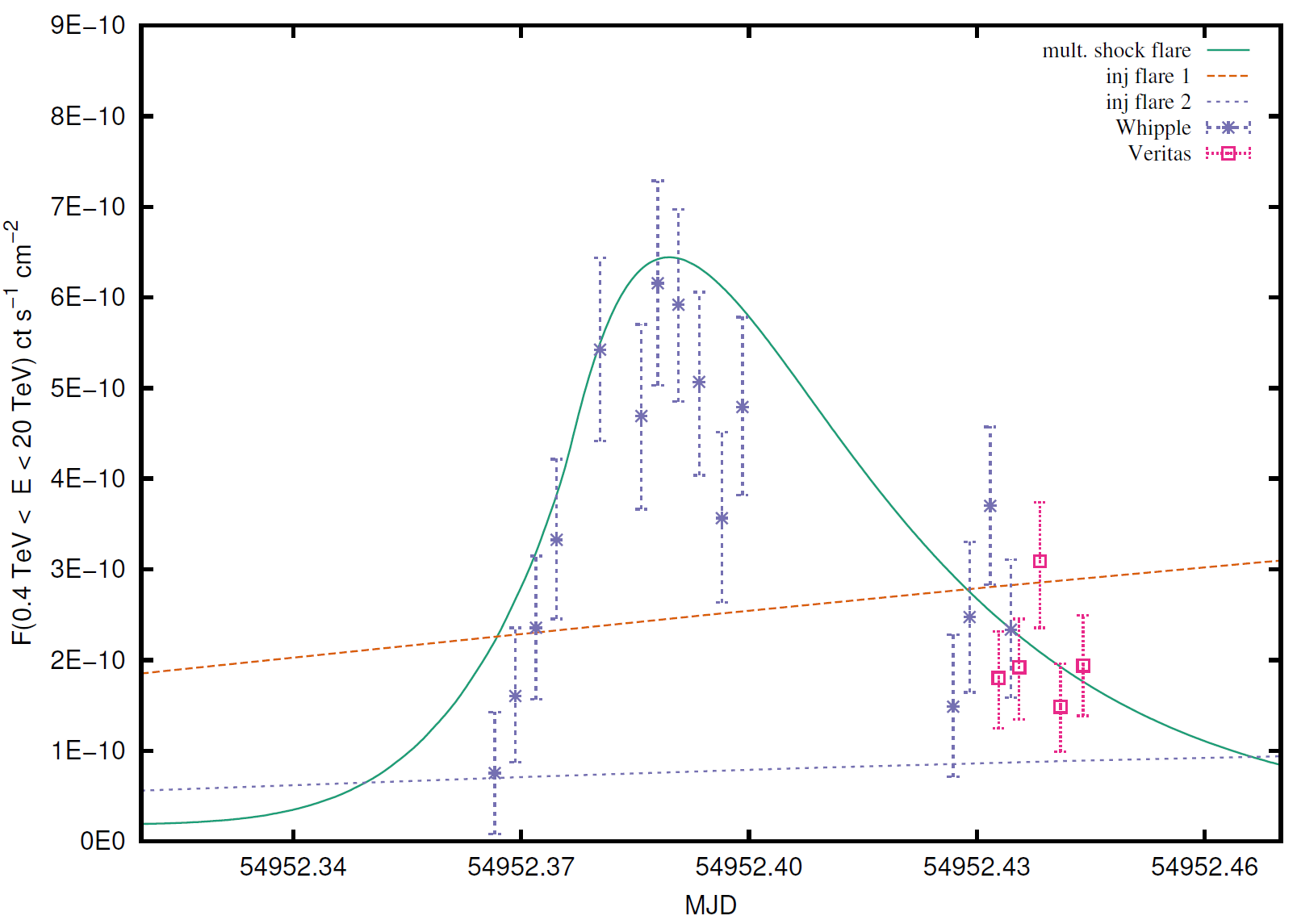 Lichtkurven für verschiedene Variabilitätsszenarien inklusive Messdaten Quelle: Multi-band implications of external-IC flares (Richter and Spanier 2015 Astroparticle Physics ) |
Research
Active Galactic Nuclei (AGN) are one of the most important source classes in high energy astrophysics. AGNs form a large class of sources, of which in particular blazars are most important. AGNs are first on the one hand a compact region in the center of a galaxy, which has a significantly increased luminosity over large parts of the electromagnetic spectrum. These compact regions have three constituent elements: a supermassive black hole, around which an accretion disk is formed, and a plasma emission perpendicular to it, the jet.
Leptonic Models
|
The first modeling of AGN with leptonic models was undertaken with the SED code. Here, a given spectrum of electron energy is injected into a homogeneous radiation zone. Various radiation processes (synchrotron radiation, ynchrotron self-absorption, inverse Compton scattering) take place there. The equations for electron and photon distribution are solved as a function of time. A time-dependent SSC model is effectively implemented. This code was e.g. used for modeling 1ES1218 + 30.4 (Spectral modelling of 1 ES 1218+30.4 (Rüger, Spanier, and Mannheim 2010 Monthly Notices of the Royal Astronomical Society )) This model enables not only the modeling of static spectra, but also, to a certain extent, the modeling of the variability. While the radiation processes - and the associated development of the particle distribution - are represented in a self-consistent manner, variability is only due to external factors (e.g. a sudden change in the injected particle spectrum). |
Model of 1ES1218+30.4 using the SED code. Source: (Spectral modelling of 1 ES 1218+30.4 (Rüger, Spanier, and Mannheim 2010 Monthly Notices of the Royal Astronomical Society)) |
|
The COJONES code was developed to model the particle spectrum self-consistently. It differs from the SED code essentially in that, instead of a single homogeneous radiation zone, it contains an acceleration zone and a radiation zone. In the acceleration zone, the kinetic equation of the electrons is solved, whereby Fermi-I and -II acceleration are taken into account. This enables acceleration and radiation to be simulated simultaneously and in a self-consistent manner. A typical scenario here is the modeling of variability by changing the injection of primary particles. Since these are then also accelerated, a different - and more complex - pattern results than with the simple SED model. A first application is the source 1ES 1218 + 30.4 ( Modeling the variability of 1ES1218 + 30.4 (Weidinger and Spanier 2010 Astronomy and Astrophysics) ) This source was already modeled with SED, but the aim here was to show that more recent observations with VERITAS are still compatible with a leptonic model. The time-dependent solution of the kinetic equations makes it possible to model the variability in a self-consistent manner. Here in the picture on the right you can ultimately see the response function of the system to a step-like change in the injected density. It can be seen that the rise and fall of the light curve are not symmetrical to one another (the rise is determined by the time scales of the acceleration, the fall by the cooling time scales). Furthermore, the light curves in the various bands are also significantly different from one another. |
Model of 1ES1218+30.4 in low flux state using the COJONES code. Source: Modelling the variability of 1ES1218+30.4 (Weidinger and Spanier 2010 Astronomy and Astrophysics ) Light curve of 1ES1218+30.4 using the COJONES code. Source: Modelling the variability of 1ES1218+30.4 (Weidinger and Spanier 2010 Astronomy and Astrophysics ) |
|
The COJONES model was also used for significantly more complex variability patterns, e.g. the extreme short-term variability of PKS 2155-30.4 With this source, a complex variability pattern in the minute range was measured. In Modeling the steady state spectral energy distribution of the BL-Lac Object PKS 2155-30.4 using a self-consistent SSC model (Weidinger, Rüger, and Spanier 2010 Astrophysics and Space Sciences Transactions) this pattern could be reproduced (see figure on the right). While the acceleration and radiation model is inherently consistent, the external change in density cannot be explained in the model. Whether a change in the external density is actually responsible for the variability can be determined by means of multiband analyzes, since the behavior in other frequencies should show characteristic changes. |
Model of the extreme short-time variability of PKS 2155 using the COJONES Code. Quelle: Modelling the steady state spectral energy distribution of the BL-Lac Object PKS 2155-30.4 using a selfconsistent SSC model (Weidinger, Rüger, and Spanier 2010 Astrophysics and Space Sciences Transactions ) |
Hadronic models
|
In many AGNs, not only electrons but also protons are accelerated to non-thermal energies. These protons can then also contribute to the radiation. In the simplest case, the contribution of the protons is only synchrotron radiation from the protons (the high magnetic fields required for this are usually present, since high magnetic fields are also necessary to keep the protons in the source). However, proton-proton or proton-photon collisions can also produce secondary particles that contribute to the radiation. In most AGN the matter density is far too low for the p-p processes to play a role. p-γ-processes, however, are often relevant. This creates neutral pions π0, which in turn decay while emitting two photons, and charged pions π±, ultimately decay into electrons and positrons. These particles can emit synchrotron radiation at any time. The final electrons and positrons can in turn play a role through pair creation and annihilation. The determination of the scattering cross-sections plays an important role. A mathematically easy-to-use method was found in Simplified Models for Photohadronic Interactions in Cosmic Accelerators (Hümmer, Rüger, Spanier, and Winter 2010 The Astrophysical Journal) . The most important aspect is that double integrals over proton AND photon distribution could be avoided here. |
Parametrisation of the photo-hadronic cross-section using the Hümmer et al. model. Source: Simplified Models for Photohadronic Interactions in Cosmic Accelerators (Hümmer, Rüger, Spanier, and Winter 2010 The Astrophysical Journal ) |
|
The parameterization of the scattering cross-sections mentioned above was also used in COJONES to model hadronic sources. In addition, protons are injected into the model system, which are accelerated just like the electrons (the acceleration time for the protons alone is smaller by the squared mass factor). In addition to the leptonic processes, proton synchrotron, π0 decay, electron / positron generation from π± and pair generation / annihilation are implemented. A typical application is described in A self-consistent and time-dependent hybrid blazar emission model. Properties and application (Weidinger and Spanier 2015 Astronomy and Astrophysics) (pictures on the right). The spectral energy distribution shows slight differences here with 1ES1011 - the high energy range is essentially flatter than the synchrotron peak. The 1ES1011 source is, however, a source at the transition area between HBL and LBL sources. For Flat Spectrum Radio Quasars it is expected that the influence of the protons will be stronger. A clearly different picture emerges when looking at light curves: In leptonic models, the light curves in individual bands do not differ very clearly, more typically the shape is similar, but there is usually a time shift. Here you can see, however, that very different shapes and even so-called orphan flares can arise, i.e. strong increases in flow in one energy band that do not occur in other bands. This can be explained by the fact that the time scales and emission processes decouple electrons and protons. While the electrons are accelerated quickly and radiate just as quickly when particles are injected, the protons need a very long time to reach relevant energies. Since the electrons and positrons from p-γ collisions are relevant here in this special case, they also cascade from high energies down to low energies. From a mere consideration of the spectral energy distribution, it is usually not possible to distinguish directly between leptonic and hadronic radiation processes. The light curves, on the other hand, speak a clearer language. |
Model of 1ES1011 using the hadronic COJONES code. Source: A self-consistent and time-dependent hybrid blazar emission model. Properties and application (Weidinger and Spanier 2015 Astronomy and Astrophysics ) Light curve of 1ES1011 using the hadronic COJONES code. Source: A self-consistent and time-dependent hybrid blazar emission model. Properties and application (Weidinger and Spanier 2015 Astronomy and Astrophysics ) |
|
From the UNICORN code described below, UNICORN-0D was developed as the successor to COJONES. In addition to numerous technical innovations (CUDA support, MPI parallelization, HDF5 output), physical processes such as the synchrotron radiation of unstable particles were integrated. Due to the high speed of UNICORN-0D it was in AGN neutrino flux estimates for a realistic hybrid model (Richter and Spanier 2018, Astroparticle Physics) possible to carry out a series investigation: For a set of model sources it was investigated how many neutrinos could be detected from such a source with IceCUBE. The magnetic field and the injection rates of electrons and protons were varied over a wide range. It turns out that a simple connection between gamma observations and neutrino detection is not possible. The estimate "one photon = one neutrino" is therefore not tenable. |
Simulated IceCUBE detection rate. Source: AGN neutrino flux estimates for a realistic hybrid model (Richter und Spanier 2018, Astroparticle Physics) |
Spatially resolved models
|
A further development of AGN modeling is spatially resolved modeling with the UNICORN code: Here the simulation area is divided in the jet direction. The particle acceleration is represented by particle scattering on an artificial fluid shock. One application is the long-wave radio emission from AGN. Previous AGN models were not able to hit the data at very low frequencies. The paradigm for this has been "The radiation is generated by cooled electrons". With UNICORN there was an opportunity to test this paradigm. In A Numerical Model of Parsec-scale SSC Morphologies and Their Radio Emission (Richter and Spanier 2016 The Astrophysical Journal) shows that the electron cooling in a cylindrical jet would not be efficient enough. In fact, it can be shown from the measurement data that the correct radio data can only be obtained assuming a logarithmic jet profile. The picture on the right shows the one for Markarian 501. |
SED of Mrk 501 for different jet forms. Only for a logarithmic shape the model data and the observational data conincide. Source: A Numerical Model of Parsec-scale SSC Morphologies and Their Radio Emission (Richter and Spanier 2016 The Astrophysical Journal ) |
|
Another problem can be tackled with spatially resolved models: For variability scenarios it is usually assumed that some variable changes. Where this change comes from is not specified. With UNICORN it is now possible to test a specific physical model: multiple shocks. In Multi-band implications of external-IC flares (Richter and Spanier 2015 Astroparticle Physics ) it was compared how light curves differ for different scenarios. In fact, for a certain set of observations, it was shown that only multiple shocks can explain the light curves. |
Light curves for different variability scenarios including the observational data. Source: Multi-band implications of external-IC flares (Richter and Spanier 2015 Astroparticle Physics ) |