Astrophysik und Plasmaphysik sind sehr eng miteinander verbunden: Nahezu alle Objekte der Astrophysik sind im Plasmazustand. Dementsprechend lassen sich viele astrophysikalische Prozesse nur verstehen, wenn man Plasmaphysik dabei berücksichtigt. Ich beschäftige mich vornehmlich mit Instabilitäten und nichtlinearen Interaktionen in Plasmen. Neben diesen reinen plasmaphysikalischen Effekten spielt Plasma aber auch in meiner Forschung zu Teilchenbeschleunigung, Turbulenz und Transporttheorie ein wichtige Rolle.
Plasmen haben eine große Zahl von Eigenmoden, in die man Fluktuationen zerlegen kann. Die erste nichtlineare Ordnung von Wechselwirkung ist die Dreiwellen-Wechselwirkung. Viele nichtlineare Phänome der Plasmaphysik lassen sich schon mit dieser einfachen Beschreibung erklären. Der Ansatz ist dabei Plasmawellen als Pseudoteilchen mit Impuls und Energie zu betrachten, womit der Zusammenstoß von zwei Wellen durch Impuls- und Energieerhaltung beschrieben werden kann.
Für die Beschreibung von Turbulenz in inkompressiblen MHD-Plasmen folgt aus einer solchen Betrachtung dann z.B. direkt das anisotrope Turbulenzmodell von Goldreich & Sridhar. Eine analytische Rechnung für dispersive Plasmen (Three-wave interactions of dispersive plasma waves propagating parallel to the magnetic field (Spanier and Vainio 2008 arXiv e-prints )) zeigt dann aber auch die Grenzen einer einfachen Beschreibung auf: Durch Dispersionseffekte werden die Impuls- und Energieerhaltungsgleichungen schnell komplex. Allerdings kann auch gezeigt werden, dass die Pseudoteilchenbeschreibung den Drehimpuls ebenso erhält. Dies wiederum führt zu Konsequenzen für die Polarisation von Plasmawellen.
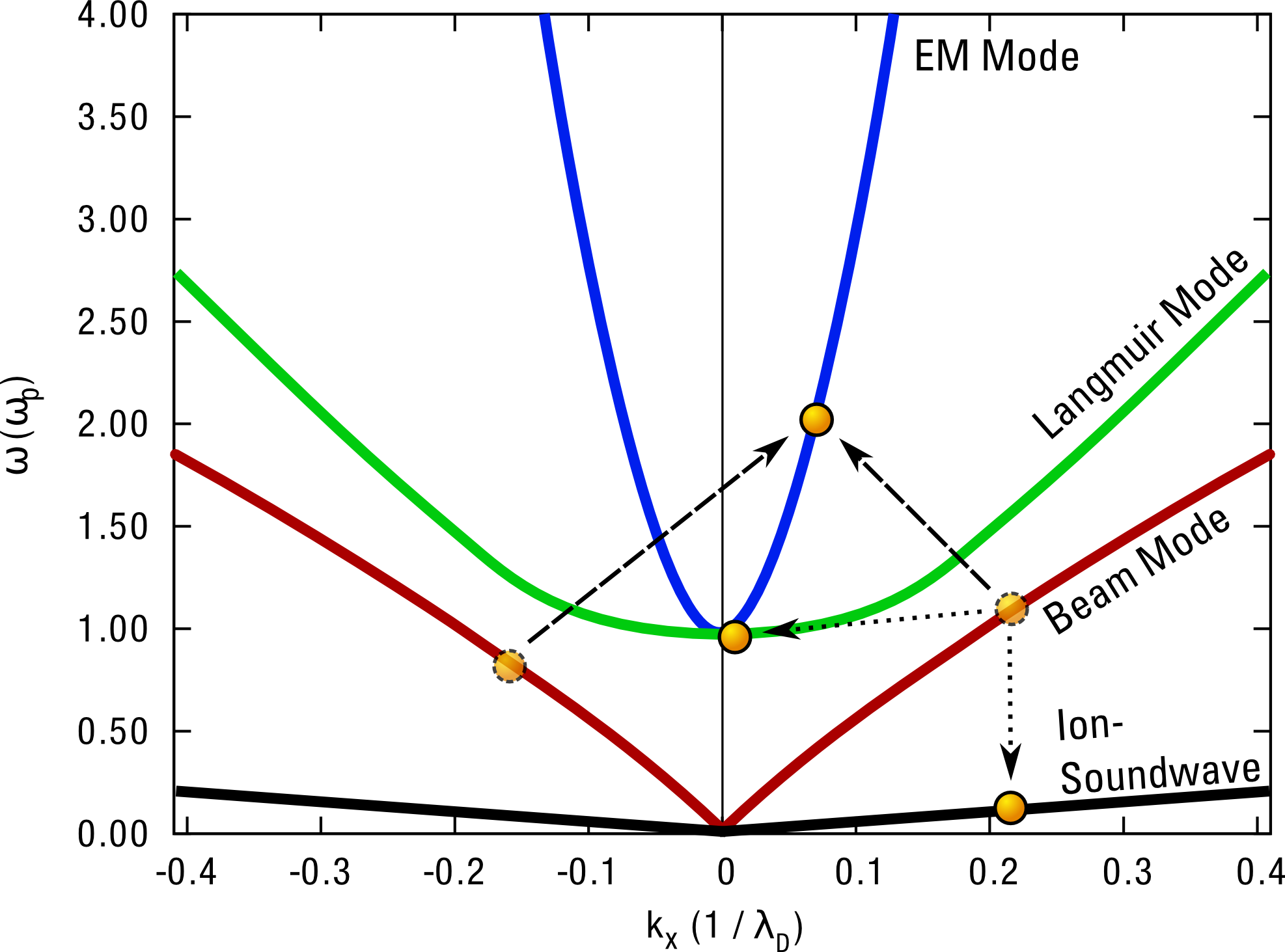
Eine sehr konkrete Anwendung von Dreiwellen-Wechselwirkung sind Type II Radiobursts, wie sie auf der Sonne beobachtet werden. Die Messungen zeigen dabei nicht nur eine fundamentale Emission sondern immer auch eine Emission bei der ersten Harmonischen. Durch Computersimulationen mit dem ACRONYM-Code war es möglich, dieses Szenario nachzubilden (Nonlinear Wave Interactions as Emission Process of Type II Radio Bursts (Ganse, Kilian, Spanier, and Vainio 2012 The Astrophysical Journal )). Hierbei wird angenommen, dass Elektronen an einer Schockfront beschleunigt werden. Diese Elektronen regen dann eine Beammode an - eine spezielle Plasmamode, die existiert, wenn hochenergetische Teilchen durch das Plasma strömen. Durch mehrer Wellenwechselwirkungen können dann sowohl fundamentale und harmonische Emission erklärt werden.
|
||
| Mögliche Interaktionen von Wellen im Type II-Szenario aus Nonlinear Wave Interactions as Emission Process of Type II Radio Bursts (Ganse, Kilian, Spanier, and Vainio 2012 The Astrophysical Journal ). Gegenläufige Beam Moden können zu EM-Moden interagieren. Je nachdem, welche Kombination gewählt wird, ergibt sich fundamentale oder harmonische Emission. |
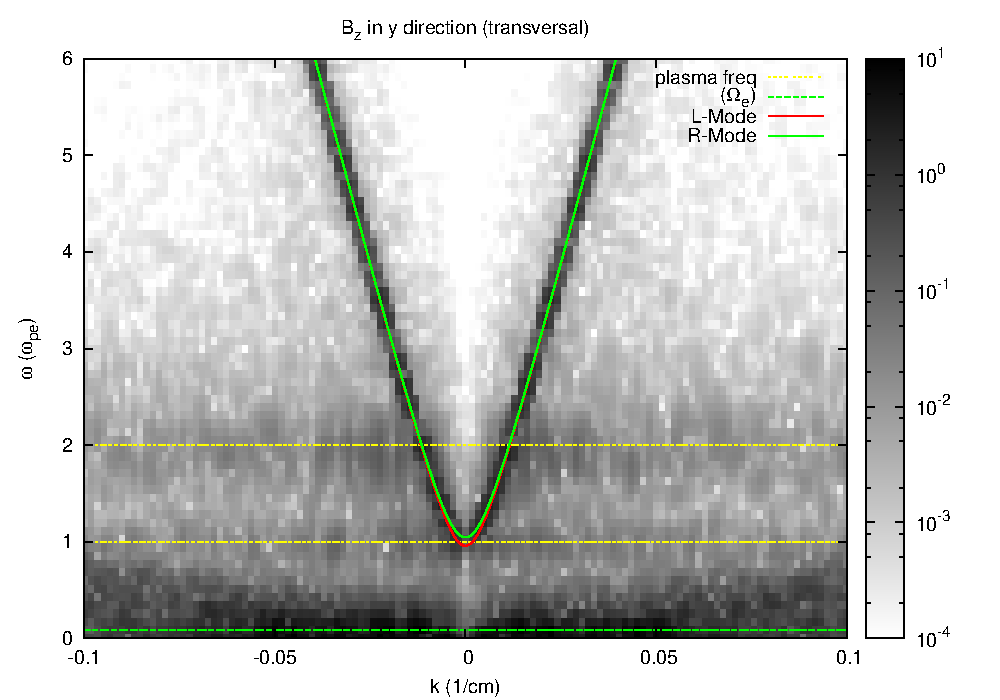
Da über die Geometrie der Emissionsegion auf der Sonne nur wenig bekannt ist, kann man mit numerischen Methoden jedes Szenarion durchspielen: Emission of Type II Radio Bursts - Single-Beam Versus Two-Beam Scenario (Ganse, Kilian, Vainio, and Spanier 2012 Solar Physics ), Fundamental and harmonic plasma emission in different plasma environments (Ganse, Kilian, Spanier, and Vainio 2014 Astronomy and Astrophysics ). Durch Vergleich von zahlreichen Realisierungen mit Messdaten ist es dann möglich, das physikalische Szenario näher einzuschränken.
 |
||
| Energieverteilung im k-ω-Diagramm aus einer PiC-Simulation (Emission of Type II Radio Bursts - Single-Beam Versus Two-Beam Scenario (Ganse, Kilian, Vainio, and Spanier, 2012 Solar Physics )). |
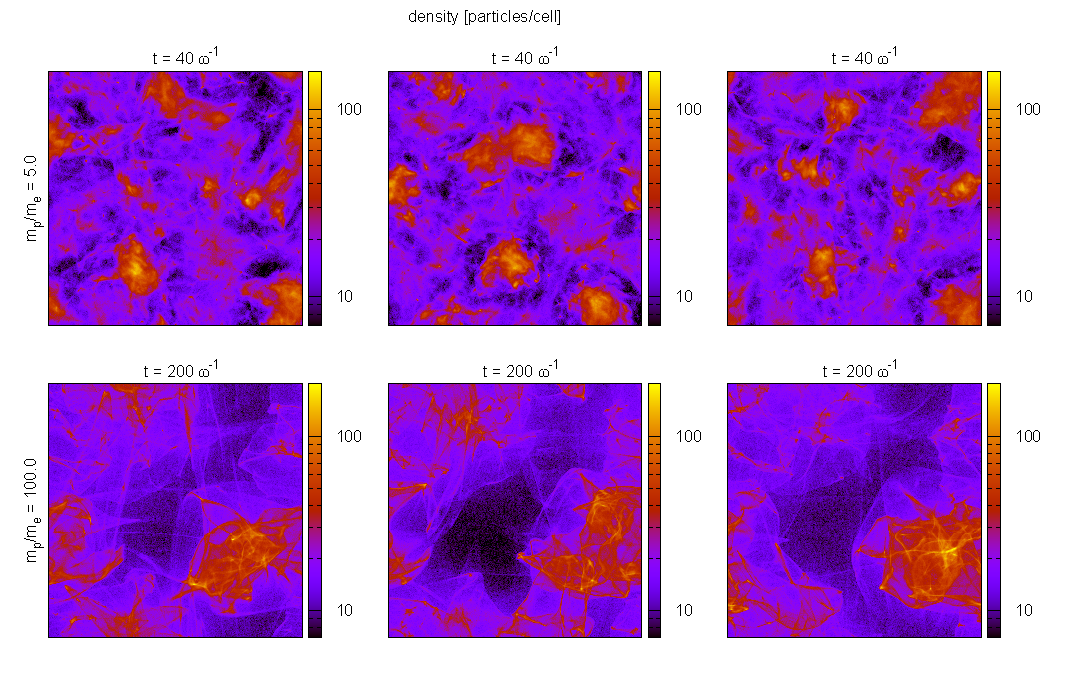
Ein weiterer wichtiger Aspekt meiner Forschung sind Instabilitäten in Plasmen. Insbesondere kinetische Instabilitäten - wie sie z.B. durch hochenergetische Teilchen in Plasmen angeregt werden. Eine der ersten Anwendungen des ACRONYM-Codes war ebenfalls die Simulation einer Instabilität: Die Filamentierungsinstabilität ( The Influence of the Mass Ratio on Particle Acceleration by the Filamentation Instability (Kilian, Burkart, and Spanier 2012, High Performance Computing in Science and Engineering '11) , The Influence of the Mass Ratio on the Acceleration of Particles by Filamentation Instabilities (Burkart, Elbracht, Ganse, and Spanier 2010 The Astrophysical Journal)) Die Filamentierungsinstabilität entsteht in unmagnetisierten Plasmen, wenn zwei warme Plasmen gegeneinander strömen. Die Filamentierungsinstabilität kann - ähnlich wie die verwandte Weibel-Instabilität - Saatmagnetfelder in unmagnetisierten Plasmen erzeugen und gleichzeitig geladene Teilchen beschleunigen.
 |
||
| Ausbildung von magnetischen Flußröhren durch die Filamentierungsinstabilität. The Influence of the Mass Ratio on the Acceleration of Particles by Filamentation Instabilities (Burkart, Elbracht, Ganse, and Spanier 2010 The Astrophysical Journal) |
Ein Anwendungsfall für Instabilitäten in der Astrophysik ist die Paarinstabilität, die durch TeV-Photonen von Blazaren erzeugt wird. Es ist bekannt, dass TeV-Photonen von weit entfernten Quellen am extragalaktischen Hintergrundlicht Elektron-Positron-Paare erzeugen. Diese können durch Compton-Streuung am kosmischen Mikrowellenhintergrund GeV-Photonen erzeugen. Neronov & Vovk (2019) haben aus der Tatsache, dass genau diese GeV-Photonen nicht beobachtet werden, die Sträke des intergalaktischen Magnetfeldes abgeschätzt, welches die Elektronen ablenkt. Broderick et al. (2012) haben hingegen argumentiert, dass die Elektronen durch Instabilitäten eher abgelenkt werden. Durch PiC-Simulationen haben wir ebenfalls versucht, diesen Effekt zu untersuchen: Energy loss in intergalactic pair beams: Particle-in-cell simulation (Kempf, Kilian, and Spanier 2016 Astronomy and Astrophysics ). Die Kontroverse dazu hält allerdings immer noch an.
Im Kontext von Teilchentransport kommt auch die Frage auf, wie hochenergetische Teilchen, die durch ein Plasma diffundieren, ihre Umgebung verändern. Auch wenn die angeregte Instabilität nicht in der Magnetohydrodynamik erklärt werden kann, so kann man die folgende Evolution durchaus mit MHD-Simulationen Evolution of plasma turbulence excited with particle beams (Lange and Spanier 2012 Astronomy and Astrophysics ) beschrieben werden. Bei diesen Simulationen mit dem GISMO-Code konnte gezeigt werden, dass diese Evolution der kritischen Balance von Goldreich&Sridhar folgt.
Neben der Bestimmung des Modenwachstums ist es auch interessant, zu bestimmen, wie stark einzelne Moden gedämpft werden. Interessamterweise ist für einen relativ einfachen Prozess wie die Zyklotrondämpfung die Dämpfungsrate analytisch nicht bekannt. Mit PiC-Simulationen (Recovering the Damping Rates of Cyclotron Damped Plasma Waves from Simulation Data (Schreiner, Kilian, and Spanier 2017 Communications in Computational Physics )) kann man hier Abhilfe schaffen.
Astrophysics and plasma physics are very closely related: Almost all objects in astrophysics are in the plasma state. Accordingly, many astrophysical processes can only be understood if plasma physics is taken into account. I am mainly concerned with instabilities and nonlinear interactions in plasmas. In addition to these pure plasma-physical effects, plasma also plays a role in my research href = "acceleration.shtml"> particle acceleration , turbulence and transport theory play an important role.
Plasmas have a large number of eigenmodes into which fluctuations can be broken down. The first nonlinear order of interaction is the three-wave interaction. Many non-linear phenomena in plasma physics can be explained with this simple description. The approach is to consider plasma waves as pseudoparticles with momentum and energy, with which the collision of two waves can be described by the conservation of momentum and energy.
For the description of turbulence in incompressible MHD plasmas, such a consideration then e.g. directly the anisotropic turbulence model of Goldreich & amp; Sridhar. An analytical calculation for dispersive plasmas ( Three-wave interactions of dispersive plasma waves propagating parallel to the magnetic field (Spanier and Vainio 2008 arXiv e-prints) ) then also shows the limits of a simple description: Due to dispersion effects, the momentum and energy conservation equations quickly become complex. However, it can also be shown that the pseudoparticle description also receives the angular momentum. This in turn has consequences for the polarization of plasma waves.
A very concrete application of three-wave interaction are Type II radio bursts as observed on the Sun. The measurements show not only a fundamental emission but also an emission at the first harmonic. Computer simulations with the ACRONYM code made it possible to recreate this scenario ( Nonlinear Wave Interactions as Emission Process of Type II Radio Bursts (Ganse, Kilian, Spanier, and Vainio 2012 The Astrophysical Journal) ). It is assumed here that electrons are accelerated on a shock front. These electrons then stimulate a beam mode - a special plasma mode that exists when high-energy particles flow through the plasma. Several wave interactions can then explain both fundamental and harmonic emissions.
|
||
| Possible interactions of waves in the Type II scenario from Nonlinear Wave Interactions as Emission Process of Type II Radio Bursts (Ganse, Kilian, Spanier, and Vainio 2012 The Astrophysical Journal) . Opposing beam modes can interact with EM modes. Depending on which combination is chosen, the result is fundamental or harmonic emission. |
Since little is known about the geometry of the emission region on the sun, each scenario can be run through with numerical methods: Emission of Type II Radio Bursts - Single-Beam Versus Two-Beam Scenario (Ganse, Kilian, Vainio, and Spanier 2012 Solar Physics) , Fundamental and harmonic plasma emission in different plasma environments (Ganse, Kilian, Spanier, and Vainio 2014 Astronomy and Astrophysics) . By comparing numerous realizations with measurement data, it is then possible to narrow down the physical scenario more closely.
|
||
| Energy distributin in k-ω-space from a PiC simulation (Emission of Type II Radio Bursts - Single-Beam Versus Two-Beam Scenario (Ganse, Kilian, Vainio, and Spanier, 2012 Solar Physics )). |
Another important aspect of my research is instabilities in plasmas. In particular kinetic instabilities - as they are e.g. are excited by high-energy particles in plasmas. One of the first applications of the ACRONYM code was also the simulation of an instability: The filamentation instability ( The Influence of the Mass Ratio on Particle Acceleration by the Filamentation Instability (Kilian, Burkart, and Spanier 2012 , High Performance Computing in Science and Engineering '11) , The Influence of the Mass Ratio on the Acceleration of Particles by Filamentation Instabilities (Burkart, Elbracht, Ganse, and Spanier 2010 The Astrophysical Journal) ) The filamentation instability arises in unmagnetized plasmas when two warm plasmas flow against each other. The filament instability can - similar to the related Weibel instability - generate seed magnetic fields in unmagnetized plasmas and at the same time accelerate charged particles.
|
||
| Formation of magnetic flux tubes by the filamentation instability. The Influence of the Mass Ratio on the Acceleration of Particles by Filamentation Instabilities (Burkart, Elbracht, Ganse, and Spanier 2010 The Astrophysical Journal) |
One use case for instabilities in astrophysics is the pair instability, which is generated by TeV photons from blazars. It is known that TeV photons from distant sources generate electron-positron pairs in the extragalactic background light. These can generate GeV photons through Compton scattering on the cosmic microwave background. Neronov & amp; Vovk (2019) have estimated the strength of the intergalactic magnetic field, which deflects the electrons, from the fact that precisely these GeV photons are not observed. Broderick et al. (2012) have argued that the electrons tend to be deflected by instabilities. We also tried to investigate this effect using PiC simulations: Energy loss in intergalactic pair beams: Particle-in-cell simulation (Kempf, Kilian, and Spanier 2016 Astronomy and Astrophysics) . However, the controversy continues.
In the context of particle transport , the question arises as to how high-energy particles that diffuse through a plasma change their environment. Even if the excited instability cannot be explained in terms of magnetohydrodynamics, the following evolution can certainly be explained with MHD simulations Evolution of plasma turbulence excited with particle beams (Lange and Spanier 2012 Astronomy and Astrophysics) . In these simulations with the GISMO code it could be shown that this evolution follows the critical balance of Goldreich & amp; Sridhar.
In addition to determining the mode growth, it is also interesting to determine how much individual modes are attenuated. Interestingly, for a relatively simple process like cyclotron damping, the damping rate is not analytically known. PiC simulationen (Recovering the Damping Rates of Cyclotron Damped Plasma Waves from Simulation Data (Schreiner, Kilian, and Spanier 2017 Communications in Computational Physics )) are a useful tool in this case.