Forschung

Research

Aktive Galaktische Kerne

Aktive Galaktische Kerne (AGN) - insbesondere die Klasse der Blazare - sind für die Hochenergieastrophysik sehr interessante Objekte, da sie viele besondere Eigenschaften haben: Sie weisen elektromagnetische Emissionen über einen weiten Energiebereich (Radio- bis Gammabereich) auf, ihre Variabilität reicht von Sekunden bis zu Jahren und sie werden als potentielle Quellen von hochenergetischen Protonen und Neutrinos angesehen.

Aus den astronomischen Beobachtungen weiß man, dass Aktive Galaktische Kerne als zentrales Element ein supermassives schwarzes Loch enthalten, dass als Motor für extrem schnelle Plasmajets dient. In diesen Plasmajets können sich Schockfronten ausbilden, in denen Teilchen beschleunigt werden, die wiederum verantwortlich sind für das breite elektromagnetische Strahlungsspektrum

Meine Forschung beschäftigt sich mit der Frage, wie das Spektrum dieser Objekte erklärt werden kann. Dazu kommen leptonische (z.B. Modelling the variability of 1ES1218+30.4 (Weidinger and Spanier 2010 Astronomy and Astrophysics )) und hadronische (A self-consistent and time-dependent hybrid blazar emission model. Properties and application (Weidinger and Spanier 2015 Astronomy and Astrophysics ) ) Strahlungsmodelle zur Anwendung. Mittlerweile wurden in meiner Arbeitsgruppe auch Codes entwickelt, die eine ortsaufgelöste A Numerical Model of Parsec-scale SSC Morphologies and Their Radio Emission (Richter and Spanier 2016 The Astrophysical Journal ) Modellierung von AGN ermöglichen.

Ziel der Forschung ist, die verschiedenen Beobachtungen (Photonen, Neutrinos, evtl. sogar Protonen und Gravitationswellen) miteinander zu verknüpfen (sog. Multi-Messenger Astronomie). Dabei sollen insbesondere selbstkonsistent aus der Teilchenverteilung das elektromagnetische Spektrum und dessen Variabilität oder gar die Struktur des Jets folgen. /p>
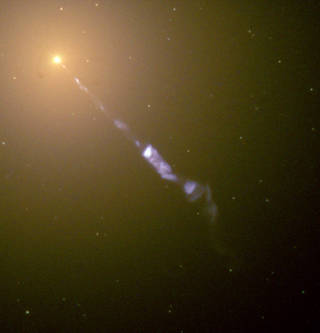
Die Aktive Galaxie M87 mit ihrem 10 kpc langen Jet.
Image credit: NASA and the Hubble Heritage Team (STScI/AURA)
Mehr

Kinetische Plasmaphysik

Plasma beschreibt den Zustand eines ionisierten Gases, in dem es eine kollektive Wechselwirkung gibt. In der Literatur wird Plasma auch als vierter Aggregatszustand bezeichnet - auch wenn das eine extreme Vereinfachung darstellt. Während Plasmen auf der Erde zwar vorkommen (Blitz, Leuchtstoffröhre, Beschichtungsreaktoren etc.), aber letztlich nur Materie in nicht ionisiertem Zustand dominiert, ist die Situation im Rest des Universums anders: Fast überall liegt Materie in einem Plasmazustand vor. Häufig liest man, daß 99% aller Materie als Plasma vorliegen.

Die mathematisch-physikalische Beschreibung von Plasmen ist dabei äußerst vielfältig. Von nicht-magnetisierten Fluidplasmen bis zu kinetischen Plasmen in starken Magnetfeldern gibt es viele Arten und Beschreibungen von Plasmen, die in verschiedenen Bereichen eine Anwendung finden.

Ich beschäftige mich vornehmlich mit der sogenannten kinetischen Plasmen - also Plasmen, bei denen die Verteilungsfunktion der Teilchen nicht Maxwell-Boltzmann ist, sondern ein Überschuß an Teilchen bei höheren Energien existiert. Viele astronomische Objekte (die Sonne, Planeten, Pulsare, Aktive Galaxienkerne etc.) beschleunigen Teilchen und produzieren damit kinetische Plasmen.

Mit Hilfe numerischer Methoden (z.B. Particle-in-Cell) untersuche ich, wie sich solche Plasmen verhalten und welchen Einfluß nichtthermische Teilchen auf das Plasma haben.

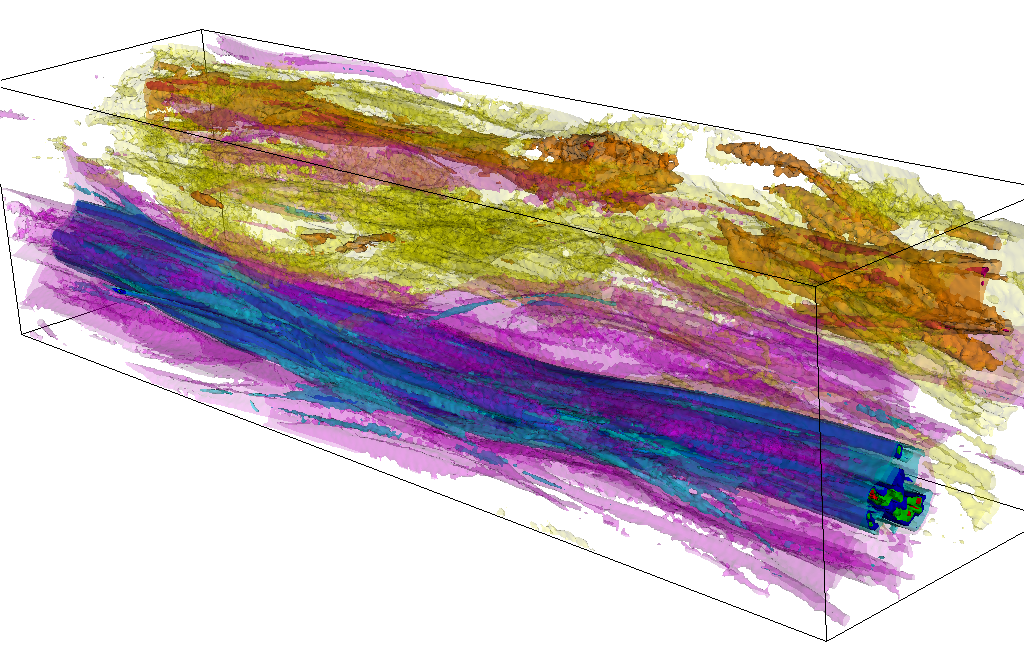
Darstellung von magnetischen Flußröhren, die durch eine Filamentierungsinstabilität hervorgerufen werden.
Image credit: T. Burkart, O. Elbracht, F. Spanier

Mehr

Turbulenz

Turbulenz kennt man aus dem Alltag von Flüssigkeiten und Gasen. Obwohl die Gleichungen die hinter (hydrodynamischer) Turbulenz einfach sind, ist die theoretische Beschreibung von Turbulenz immer noch nicht endgültig geklärt. In der Plasmaphysik werden die Gleichungen komplizierter und die in Plasmen umso komplexer.

Zu den Gebieten, mit denen ich mich beschäftige gehört die Untersuchung von Turbulenz in magnetisierten Fluidplasma (Magnetohydrodynmik, s. Evolution of plasma turbulence excited with particle beams (Lange and Spanier 2012 Astronomy and Astrophysics )) und die Turbulenz in Bereich kinetischer Plasmen. Die Fragestellungen dabei sind u.a. wie sich die Energie verteilt, wie Energie über Skalen transportiert und wie Anisotropien aussehen (oder im Fall von kinetischer Turbulenz, welche Wellenmoden bei der Turbulenz eine Rolle spielen).

Wie in vielen anderen Projekten verwende ich meist numerische Methoden wie spektrale MHD-Löser GISMO oder Particle-in-Cell Codes ACRONYM aber auch analytische Methoden Three-wave interactions of dispersive plasma waves propagating parallel to the magnetic field (Spanier and Vainio 2008 arXiv e-prints ).

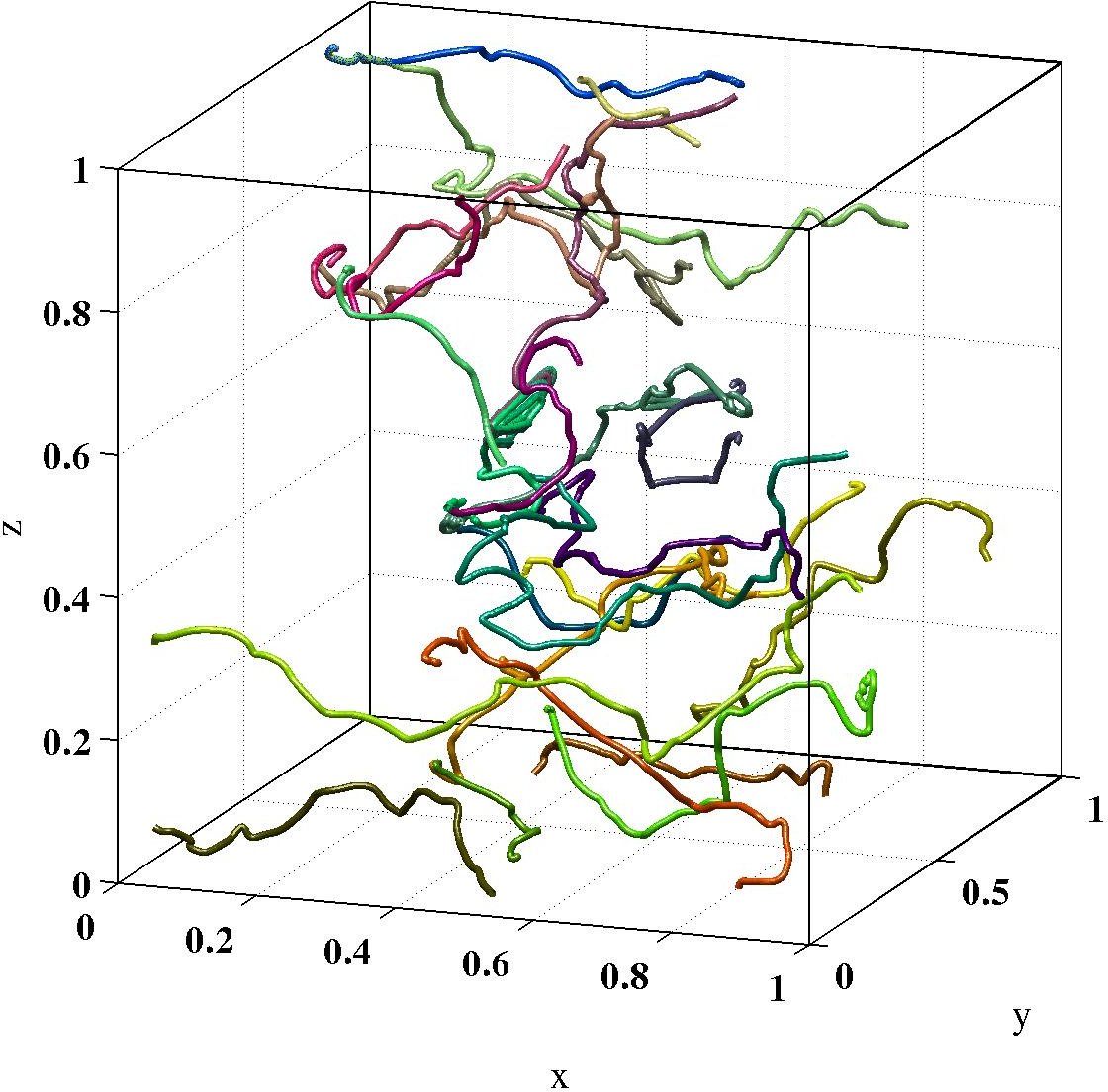
Magnetische Feldlinien in kompressibler MHD-Turbulenz
Image credit: Turbulence evolution in MHD plasmas (Wisniewski, Kissmann, Spanier, and Spanier 2013 Journal of Plasma Physics )

Mehr

Transport kosmischer Strahlung

Eng verbunden mit der Turbulenzforschung ist die Untersuchung des Transports kosmischer Strahlung: Hochenergetische geladene Teilchen in der Heliosphäre und dem interstellaren Medium werden durch die Wechselwirkung von Teilchen mit turbulenten Magnetfeldern gestreut. Dabei wird angenommen, dass sich die turbulenten Störungen als Wellen zerlegen lassen.

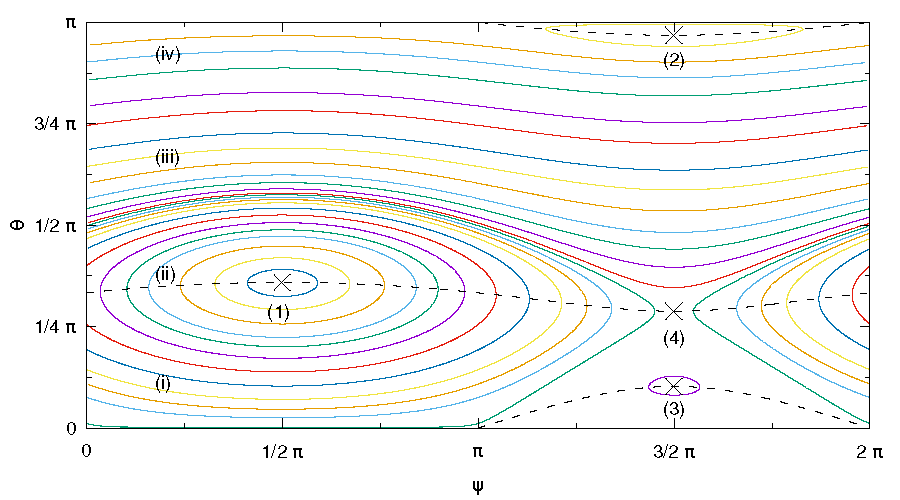
Es zeigt sich, dass schon für den Fall der Wechselwirkung eines Teilchens mit einer einzelnen Wellen eine analytische Lösung extrem kompliziert ist (Analytical treatment of particle motion in circularly polarized slab-mode wave fields (Schreiner, Vainio, and Spanier 2018 Journal of Plasma Physics ) ). Daher verwende ich verschiedene numerische Modelle, um die Eigenschaften des Teilchentransports zu bestimmen.

Mit dem inkompressiblen MHD-Code GISMO lässt sich die Bewegung von Testteilchen in inkompressibler MHD-Turbulenz berechnen (Particle scattering in turbulent plasmas with amplified wave modes (Lange, Spanier et al. 2013 Astronomy and Astrophysics )). Für dispersive Wellenmoden bietet sich die Simulation mit ACRONYM an (Wave-particle-interaction in kinetic plasmas (Schreiner and Spanier 2014 Computer Physics Communications ) , Particle Scattering off of Right-Handed Dispersive Waves (Schreiner, Kilian, and Spanier 2017 The Astrophysical Journal ) ). Ein Problem bei solchen Simulationen ist die tatsächliche Bestimmung von Transportparametern aus der Simulation. Die Bestimmung quasi-linearer Parameter aus nichtlinearen Simulationen gelingt z.B. besser mit neu entwickelten Methoden Determining Pitch-angle Diffusion Coefficients from Test Particle Simulations (Ivascenko, Lange, Spanier, and Vainio 2016 The Astrophysical Journal ) .

Mehr

Phasenraumdiagramm für Welle-Teilchen-Wechselwirkung
Image credit: Analytical treatment of particle motion in circularly polarized slab-mode wave fields (Schreiner, Vainio, and Spanier 2018 Journal of Plasma Physics )

Schocks und Teilchenbeschleunigung

Die Existenz hochenergetischer kosmischer Strahlung ist seit langem bekannt, viele Quellen sind auch bekannt (die Sonne, Pulsare, Aktive Galaktische Kerne etc.). Über die Frage, wie Teilchen zu höchsten Energien beschleunigt werden, besteht aber noch Uneinigkeit.

Zu den wahrscheinlichsten Beschleunigungsmechanismen gehört die Beschleunigung an Schockfronten. Dieser Mechanismus lässt sich an der Sonne oder im Sonnenwind auch am Merkur (Kinetic Simulations of Electron Acceleration at Mercury (Büchner, Kilian et al.} , 2018, Magnetic Fields in the Solar System ) ) beobachten. In Aktiven Galaktischen Kernen kann man die Schockfronten zwar beobachten, aber es lässt sich nur schwer in situ beobachten, wie Teilchen beschleunigt werden. Nur durch die Modellierung von Strahlung (A Numerical Model of Parsec-scale SSC Morphologies and Their Radio Emission (Richter and Spanier 2016 The Astrophysical Journal ) ) kann man implizit sein Beschleunigunsmodell verifizieren.

Ich untersuche mikrophysikalisch mit Particle-in-Cell codes aber auch makrophysikalisch mit AGN-Modellierung mögliche Schockbeschleunigunsszenarien. Dabei spielt die Entwicklung neuer numerischer Methoden auch eine wichtige Rolle ( Simulating the injection of magnetized plasma without electromagnetic precursor wave (Kilian and Spanier 2018 Journal of Computational Physics ))

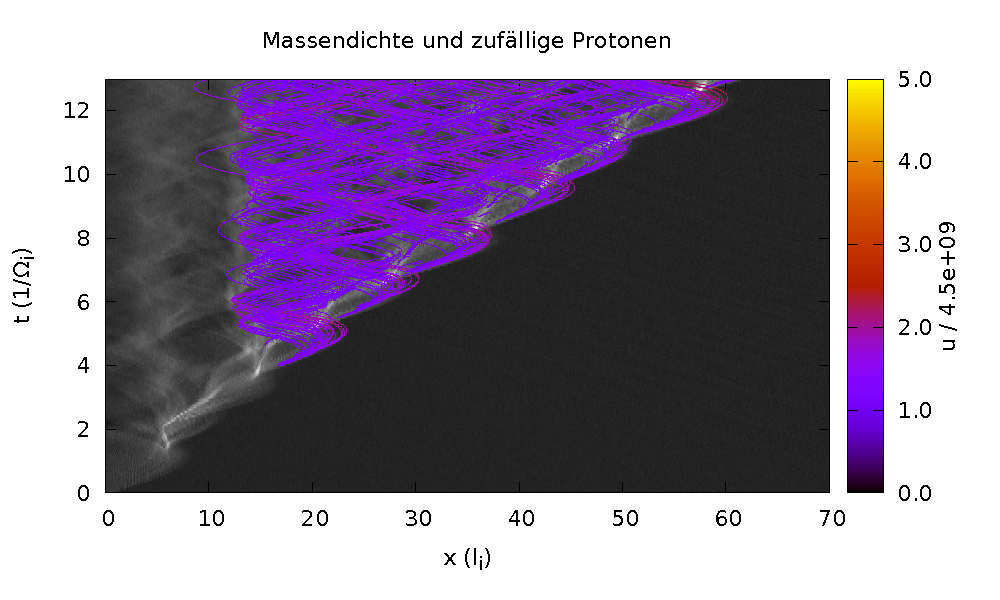
Teilchenbahnen an einer Schockfront. PiC-Simulation
Image credit: Teilchenbeschleunigung an kollisionsfreien Schockfronten, Dissertation, P. Kilian, Uni Würzburg 2015 urn:nbn:de:bvb:20-opus-119023

Mehr

Plasmapyhsik in Neutrinoexperimenten

Die Messung der Neutrinomasse ist nicht direkt möglich, verschiedene Experimente versuchen aber diese indirekt zu bestimmen. Ein Weg diese zu bestimmen, ist die Bestimmung des Elektronenspektrums aus Betazerfällen. Fermi konnte schon den Einfluß der Neutrinomasse auf das Spektrum zeigen.

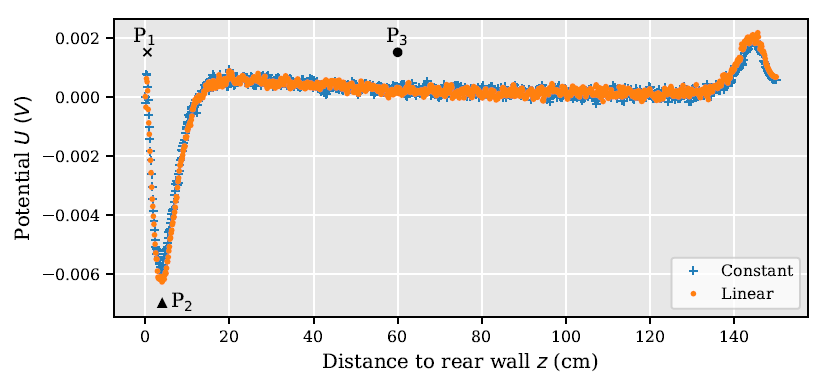
Im KATRIN-Experiment zum Beispiel wird eine große Tritiumquelle verwendet, die eine sehr große Zahl an Tritiumzerfällen liefert. Damit ist es möglich, das Spektrum im Detail zu vermessen. Dabei gibt es aber einen Haken: Die hochenergetischen Elektronen aus dem Betazerfall ionisieren das Tritiumgas. Dadurch entsteht ein Plasma, das ein elektrostatisches Potential hat. Dieses Potential ändert die Energiedifferenz zwischen Zerfallselektronen und dem Detektor.

Für eine Neutrinomassenmessung mit höchstmöglicher Präzision ist es notwendig, dieses elektrostatische Potential zu bestimmen. Dazu müssen sowohl die molekularen und atomaren Prozesse, die zur Ionisation und Rekombination führen simuliert werden als auch das Plasma selber simuliert werden.

Elektrostatischs Potential in der WGTS. PiC-Simulation
Image credit: Simulation of the KATRIN Source Plasma using Monte Carlo and Particle in Cell Methods, Dissertation, J. Kellerer, KIT Karlsruhe 2022 urn:nbn:de:101:1-2022033004594613326610

Mehr

Active Galactic Nuclei

Active galactic nuclei (AGN) - especially the blazars - are very interesting objects for high energy astrophysics since they have many special properties: they emit electromagnetic emission over a wide energy range (from radio to gamma rays), their variability ranges from seconds to years and they are considered potential sources of high-energy protons and neutrinos.

From the astronomical observations it is known that the central element of active galactic nuclei is a super massiveblack hole that serves as an engine for extremely fast plasma jets. In these plasma jets shock fronts can form in which particles are accelerated, which in turn are responsible for the wide electromagnetic radiation spectrum.

My research is concerned with the question of how the spectrum of these objects can be explained. For this matter different models are used: Leptonic (z.B. Modelling the variability of 1ES1218+30.4 (Weidinger and Spanier 2010 Astronomy and Astrophysics )) and hadronic (A self-consistent and time-dependent hybrid blazar emission model. Properties and application (Weidinger and Spanier 2015 Astronomy and Astrophysics ) ) radiation models. My group has also developed spatially resolved radiation models A Numerical Model of Parsec-scale SSC Morphologies and Their Radio Emission (Richter and Spanier 2016 The Astrophysical Journal ) that allow for a morphological study of AGN.

The aim of the research is to link the different observations (photons, neutrinos, possibly even protons and gravitational waves) with one another (so-called multi-messenger astronomy). In particular, the electromagnetic spectrum and its variability or even the structure of the jet should follow from the particle distribution in a self-consistent manner.

The active galactic nucleus M87 with its 10 kpc long jet.
Image credit: NASA and the Hubble Heritage Team (STScI/AURA)
More

Kinetic plasma physics

Plasma describes the state of an ionized gas in which there is a collective interaction. In the literature, plasma is also referred to as the fourth state of matter - even if this represents an extreme simplification. While plasmas occur on earth (lightning, fluorescent light bulbs, coating reactors, etc.), matter in a non-ionized state ultimately dominates. The situation is different in the rest of the universe: almost everywhere, matter is in a plasma state. It is often read that 99% of all matter is in the form of plasma.

The mathematical-physical description of plasmas is extremely diverse. From non-magnetized fluid plasmas to kinetic plasmas in strong magnetic fields, there are many types and descriptions of plasmas that are used in different areas.

I mainly deal with the so-called kinetic plasmas - plasmas in which the distribution function of the particles is not Maxwell-Boltzmann, but an excess of particles exists at higher energies. Many astronomical objects (the sun, planets, pulsars, active galaxy nuclei etc.) accelerate particles and thus produce kinetic plasmas.

Using numerical methods (e.g. Particle-in-Cell) I study how plasmas behave especially in the presence of nonthermal particle distributions.

Magnetic flux tubes as they are produced by the filamentation instability.
Image credit: T. Burkart, O. Elbracht, F. Spanier

More

Turbulene

Turbulence is known from the everyday life of liquids and gases. Although the equations behind (hydrodynamic) turbulence are simple, the theoretical description of turbulence is still not completely clear. In plasma physics, the equations become more complicated and those in plasmas all the more complex.

The areas that I deal with include the investigation of turbulence in magnetized fluid plasma (magnetohydrodynamics, cf. s. Evolution of plasma turbulence excited with particle beams (Lange and Spanier 2012 Astronomy and Astrophysics ))) and the turbulence in the area of kinetic plasmas. The questions are: how the energy is distributed, how energy is transported across scales and what anisotropies look like (or in the case of kinetic turbulence, which wave modes play a role in turbulence).

As in many other project I mainly employ numerical methods like the pseudospectral MHD solber GISMO or particle-in-cell codes ACRONYM aber auch analytische Methoden Three-wave interactions of dispersive plasma waves propagating parallel to the magnetic field (Spanier and Vainio 2008 arXiv e-prints ).

Magnetic field lines in compressible MHD turbulence
Image credit: Turbulence evolution in MHD plasmas (Wisniewski, Kissmann, Spanier, and Spanier 2013 Journal of Plasma Physics )

More

Cosmic ray transport

Closely connected to turbulence research is the study of cosmic ray transport: Charged high energy particles in the heliosphere and the interstellar medium are interacting with turbulent magnetic fields. This interaction governs the transport parameters of particles. It is often assumed that the turbulent perturbations can be described as plasma waves.

Already the simplest case of interaction (one particle with one wave) yields a very complicated analytical solution (Analytical treatment of particle motion in circularly polarized slab-mode wave fields (Schreiner, Vainio, and Spanier 2018 Journal of Plasma Physics )). For this reason I use again numerical models to calculate transport parameters in different turbulence realisations.

The incompressible MHD code GISMO allows for the calculation of test particle tracks (Particle scattering in turbulent plasmas with amplified wave modes (Lange, Spanier et al. 2013 Astronomy and Astrophysics )). For dispersive wave modes simulations with ACRONYM an (Wave-particle-interaction in kinetic plasmas (Schreiner and Spanier 2014 Computer Physics Communications ) , Particle Scattering off of Right-Handed Dispersive Waves (Schreiner, Kilian, and Spanier 2017 The Astrophysical Journal ) ) can be performed. A major problem in analysing such test particle simulations is the derivation of transport parameters. A new method to derive quasi-linear parameters from nonlinear simulations has been developed. Determining Pitch-angle Diffusion Coefficients from Test Particle Simulations (Ivascenko, Lange, Spanier, and Vainio 2016 The Astrophysical Journal ) .

Phase space diagram for wave-particle interaction
Image credit: Analytical treatment of particle motion in circularly polarized slab-mode wave fields (Schreiner, Vainio, and Spanier 2018 Journal of Plasma Physics )

More

Shocks and particle acceleration

The existence of high-energy cosmic rays is known for long, as well as some of the source (e.g. the Sun, pulsars). The question how particles are accelerated to highest energies is still not solved.

One of the most important mechanism is the acceleration at shock fronts. This mechanism may be close to the Sun and in the solar wind close to Mercury (Kinetic Simulations of Electron Acceleration at Mercury (Büchner, Kilian et al.} , 2018, Magnetic Fields in the Solar System ) ) In active galactic nuclei shock fronts may be assumed, but in situ observation is impossible. Only through radiation modeling (A Numerical Model of Parsec-scale SSC Morphologies and Their Radio Emission (Richter and Spanier 2016 The Astrophysical Journal ) ) is it possible to verify certain acceleration models.

I study shock acceleration scenario on a microphysical level Particle-in-Cell codes aber as well as on macrophysical level through AGN modeling. This is only possible using numerical models, in which new methods are also developed. ( Simulating the injection of magnetized plasma without electromagnetic precursor wave (Kilian and Spanier 2018 Journal of Computational Physics ))

Particles tracks at a shock front. PiC-Simulation
Image credit: Teilchenbeschleunigung an kollisionsfreien Schockfronten, Dissertation, P. Kilian, Uni Würzburg 2015 urn:nbn:de:bvb:20-opus-119023

More

Plasmapyhsics in neutrino experiments

.

The measurement of neutrino mass is not possible directly, but various experiments attempt to determine it to determine it indirectly. One way to determine it is to determine the electron spectrum from beta decays. Fermi could already show the influence of the neutrino mass on the spectrum.

In the KATRIN experiment, for example, a large tritium source is used, which yields a very large number of Tritium decays. This makes it possible to measure the spectrum in detail. But there is one catch: The high-energy electrons from the beta decay ionize the tritium gas. This creates a plasma that has an electrostatic potential. This potential changes the energy difference between decay electrons and the detector.

For a neutrino mass measurement with the highest possible precision, it is necessary to determine this electrostatic Potential to be determined. Dazu müssen sowohl die molekularen und atomaren Prozesse, die zur Ionisation und Rekombination führen simuliert werden als auch das Plasma selber simuliert werden.

Elektrostatischs Potential in der WGTS. PiC-Simulation
Image credit: Simulation of the KATRIN Source Plasma using Monte Carlo and Particle in Cell Methods, Dissertation, J. Kellerer, KIT Karlsruhe 2022 urn:nbn:de:101:1-2022033004594613326610

More