Für das Astroteilchenphysik-Experiment KATRIN ist es notwendig, das Plasma im Inneren des Experiments zu verstehen. Die Herausforderung dabei ist, dass viele physikalische Aspekte (Ionisation, Rekombination, Plasma-Wand-Interaktion etc.) eine Rolle spielen und gleichzeitig das Plasma stark inhomogen ist. Das macht ein Multi-Skalen- und Multi-Physik-Modell notwendig.
In vorhergehenden Arbeiten wurden schon ein Monte-Carlo-Modell für atomare und molekulare Prozesse entwickelt und unabhängig ein Fluid- und ein Kinetikmodell für das Plasma verwendt. Ausgehend vom Particle-in-Cell Modell für das Plasma soll in dieser Doktorarbeit ein hybrides Modell, das sowohl Bereiche hoher als auch niedriger Dichte beschreibt, entwickelt werden. Ziel der Arbeit wird sein, eine physikalisch korrekte Darstellung des Plasmapotentials zu finden. Diese ist Grundlage für alle weiteren Auswertungen des Experiments.
Im Rahmen dieser Arbeit werden vorwiegend numerische Methoden eingesetzt - Kenntnisse in C++ sind von großem Vorteil. Grundlegende Kenntnisse in Fluiddynamik, Plasmaphysik oder Elektrodynamik sind hilfreich.
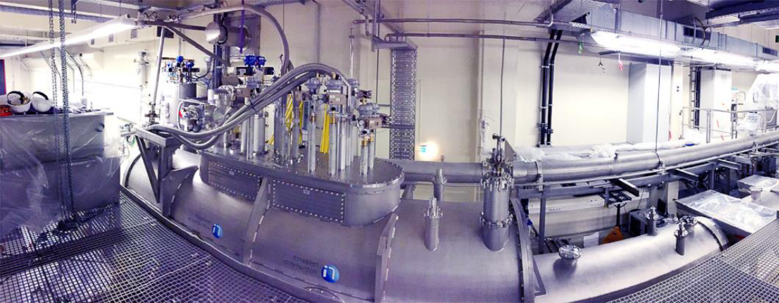
Wissenschaftliches Umfeld: KATRIN
Die Zielsetzung des internationalen Karlsruhe Tritium Neutrino (KATRIN) Experiments besteht in der modellunabhängigen Messung der fundamentalen Massenskala von Neutrinos mit einer Sensitivität von m(ν) = 200 meV zur Beantwortung von offenen Fragestellungen in der Kosmologie (heiße dunkle Materie im Universum) und der Teilchenphysik (Massenschema der Neutrinos). Hierzu wird die kinetische Energie von β-Zerfallselektronen aus einer hochintensiven molekularen gasförmigen Tritiumquelle durch ein System aus zwei elektrostatischen Spektrometern mit bisher unerreichter Präzision gemessen. Das KATRIN Experiment wurde von einer internationalen Kollaboration mit ~150 Wissenschaftlern aus D, USA, GB, CZ und RU auf dem Gelände des KIT Campus Nord aufgebaut. Seit 2019 werden die erste Daten genommen.
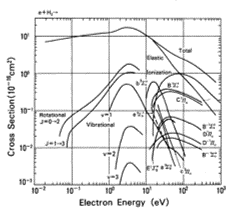
Wirkungsquerschnitte atomarer Wechselwirkungen
Experimentelles Umfeld: Fensterlose Tritiumquelle
Beim KATRIN Experiment dient ein 10 Meter langes Strahlrohr als fensterlose Quelle von hochenergetischen β-Elektronen. Hierzu wird in der Mitte des Rohrs neutrales Tritium eingelassen und an den Enden abgepumpt. Innerhalb der Quelle wird das neutrale Gas durch die β-Elektronen ionisiert. Durch die Wechselwirkung der dabei entstehenden Ionen und Sekundärelektronen bildet sich ein Plasma aus. Dieses Plasma wirkt sich durch sein elektrisches Potential bedingt auf die Startenergie der zu vermessenden β-Elektronen und damit auf die Neutrinomassenmessung aus. Durch Messungen ist es nicht möglich das Potential direkt zu bestimmen wodurch ausführliche Simulationen notwendig sind. Wesentlicher Eingangsparameter ist die Elektronenenergieverteilung.